

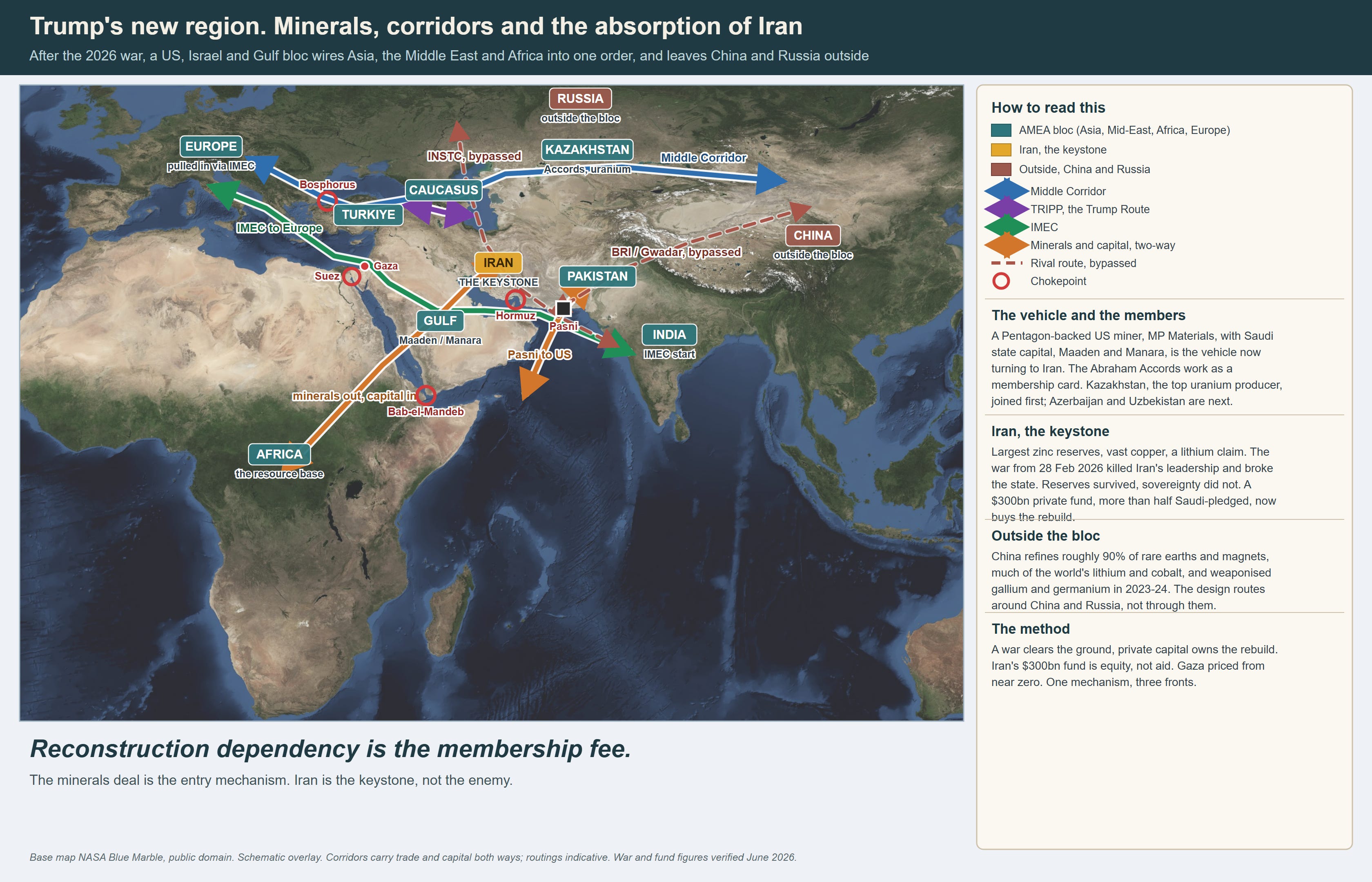
Roughly three months after the bombs stopped falling on Tehran, the shape of Iran’s reconstruction has arrived in two documents rather than one. The first is a memorandum of understanding signed on 17 June 2026 by Trump and the Iranian president, mediated by Pakistan and styled the Islamabad Memorandum, which ends the war, lifts the sanctions on an agreed schedule and commits at least 300 billion dollars to rebuilding the country. The second arrived five days later, a sweeping US Treasury licence that switches Iran’s oil exports back on and, for the first time in more than four decades, allows them to be sold and settled in dollars. Read together they are larger than a ceasefire. They are the terms of Iran membership in a new regional order powered by dollars.
The visible actor in the rebuild is a mining company. A US-Saudi minerals programme built around MP Materials, the Nevada rare-earth producer backed by the US government and the Pentagon, together with Saudi Arabia’s state mining champion Ma’aden and its investment arm Manara Minerals, has turned toward Iran’s reconstruction, moving inside the 300 billion dollar fund the memorandum created, a vehicle engineered as private investment rather than a grant or a reparations programme, capital designed to trigger investment into Iran rather than to hand money to it.
The easy reading is the spoils of war, Gulf money and an American miner picking over a country bombed into ruin between February and April. That reading is too shallow, and it misses the design entirely.
For 40 years the organising idea in the region was containment, a wall around Iran, an arc to be encircled and starved. Trump’s project inverts the geometry. The minerals deal and the dollar licence are the opening moves in something far larger than Iran, a single connected economic region stitching Asia, the Middle East and Africa into one directable space, with Europe drawn in along the India-Middle East-Europe corridor, anchored by US offshore capital, Israeli security depth and Gulf sovereign wealth, and built precisely to route around China and Russia rather than to confront them with another decade of sanctions. Call it what its own map makes it, an Asia, Middle East and Africa region (AMEA). The minerals firm is the industrial entry mechanism, the dollar licence is the monetary one, the reconstruction fund is the lever, and Iran is the keystone, not the enemy. This is not encirclement, it is absorption, and absorption is the more dangerous instrument because it does not look like a siege. It looks like an investment.
Iran is being put back inside the dollar
The war cleared the ground in 40 days. Beginning on 28 February the US and Israel launched close to 900 coordinated air strikes across Iran in under 12 hours, hitting government, military and nuclear sites in a single opening salvo, struck Tehran on 3 March, killed the Supreme Leader, and agreed a ceasefire on 7 and 8 April brokered through Pakistan. What the strikes destroyed was not Iran’s mineral wealth, which sits in the ground and cannot be bombed, but its capacity and its sovereignty, the processing, the energy, the leadership and the bargaining power. A bankrupted, decapitated state that still holds some of the largest reserves on earth is not a candidate for defiance, it is the ideal candidate for financialised absorption, because it cannot pay for its own recovery and the only capital large enough to fund the rebuild belongs to the bloc that just demolished it.
The memorandum is where the absorption is written down. Its 14 points end the war, remove the naval blockade within 30 days, hand the future administration of safe passage through the Strait of Hormuz to Oman and the Gulf littoral states, terminate the sanctions on an agreed schedule, release Iran’s frozen funds to its central bank, and commit at least 300 billion dollars of regional capital to reconstruction, with Trump insisting Washington itself will not pay. Paragraph 10 is the operative one. It instructs the US Treasury, immediately on signing, to license the export of Iranian crude, petroleum products and derivatives and, with them, all the banking, insurance and transport services that make an oil trade possible.
On 22 June the Treasury issued General License X, a 60-day waiver running to 21 August that lets Iran produce and sell crude, petrochemicals and refined products and, for the first time in more than four decades, be paid for them in dollars, with the proceeds flowing directly into the Central Bank of Iran rather than through the shadow-banking intermediaries Tehran has used to survive sanctions. The licence could release roughly 67m barrels of Iranian crude stranded in the Gulf and hand Tehran an immediate 8 billion to 9 billion dollar windfall, and it removes at a stroke the banking friction that has held Iranian volumes down, which is why the early read is that China, the buyer of roughly 90% of Iran’s oil, will now accelerate its purchases through formal dollar clearing rather than opaque channels, indirectly undermining a main channel of yuan internationalisation.
This is the move the minerals story need to be read within as dollar will likely also be used trade such materials. For more than 40 years Iran sold its oil almost entirely outside the dollar, in yuan, in barter, at a discount, through a shadow fleet and intermediary banks, and it did so deliberately, because settling outside the dollar was the one piece of monetary sovereignty that sanctions could not reach. The resistance economy was built on it. General License X reverses it. Iran’s single most important revenue stream is switched back on, but inside the dollar system, cleared under a US licence, booked through its central bank in the currency Washington controls. Minerals will also likely be expected to be traded in dollars. The autonomy Iran spent four decades constructing is surrendered in 60 revocable days for revenue and regime survival. The dollar is not the payment, it is the leash, because a licence that expires on 21 August is a licence that can be left to expire, and an oil sector that has just been re-plumbed into dollar clearing is an oil sector Washington can throttle by doing nothing at all.
The minerals deal builds the other half of the same cage. The reason a Pentagon-backed miner is planting refining capacity inside former enemy territory is that processing, not extraction, is the chokepoint of the modern economy, and one country owns it. China refines roughly 90% of the world’s rare earths and the magnets built from them, along with much of the planet’s lithium and cobalt, and in 2023 and 2024 it showed what that dominance is for by restricting gallium and germanium as instruments of policy. Turning Manara’s acquisition machine and MP Materials’ refining capability toward a bombed and bankrupt Iran is not charity, it is the construction of a non-China processing layer in the one place Washington could never previously reach. The Iranian ore matters less than the Iranian refinery, because the refinery is a node in a parallel supply chain, and the same refinery that makes Iran useful to the bloc is the refinery the bloc can switch off.
Notice what the two halves share. The oil is re-dollarised by licence, and the minerals are re-dollarised by capital. A rare-earth or base-metal project built with US and Gulf money, processed in a bloc-controlled refinery and sold into a Western supply chain is a project that prices, invoices and clears in dollars, the same dollars the oil now clears in. Iran’s two great resource streams, the one it pumps and the one it digs, are being plumbed back into a single currency at a single moment. The alternative was not hypothetical. China has spent a decade trying to drag the world’s commodity and metals trade onto the yuan, and an Iran rebuilt by Chinese capital would have fed its ore into yuan-priced Chinese supply chains the way it had been feeding its crude into yuan-settled Chinese refineries. The war foreclosed that. Stripped to its core, absorption is re-dollarisation, the recapture of an entire economy’s external earnings into the currency the bloc controls, run across oil and minerals at once because the prize was never a single commodity, it was the monetary system. Oil pays the bills and minerals build the supply chain, but both are now denominated, cleared and switchable in the same currency, and that is what makes Iran a member rather than a holdout, productive and indebted and with nothing sovereign left behind.