

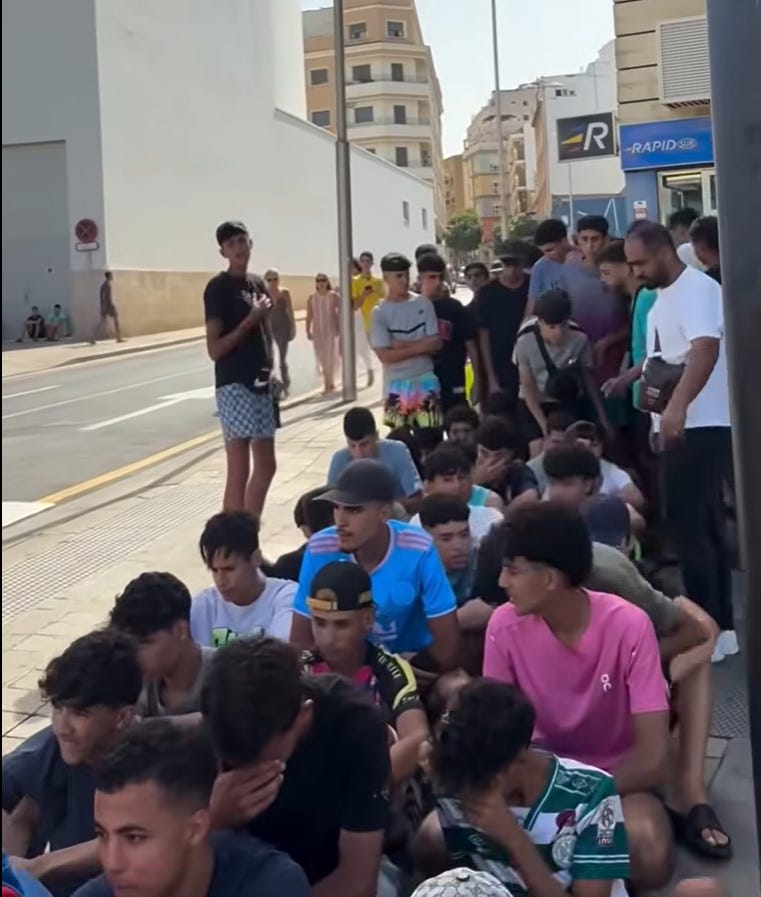
On 28 July the US signed its first federal funding agreement for a project inside Western Sahara, a 5.7 million dollar feasibility grant for a green hydrogen and ammonia complex at Laayoune whose first phase carries a 4.5 billion dollar price tag. On 30 July the fence at Ceuta opened and somewhere between 60,000 and 80,000 people walked, swam and were driven into a city of 83,000. At least 111 died. Within 24 hours 48,300 had been sent back, and by 3 August roughly 70,000 were on Moroccan soil again.
A border that could not stop 2,582 arrivals over six months stopped 70,000 in a weekend. Gendarmes opened gates. Lorries unloaded at the fence line. Moroccan intelligence officers were caught on Spanish cameras timing response intervals and mapping sensor gaps. The evidence suggests this was a state operation and Rabat ran it because the King’s new patrons wanted Spain hurt and were willing to pay for the work.
Spain said no twice
On 4 March Madrid formally refused US forces the use of Rota and Morón for the war on Iran and shut its airspace to American aircraft flying the campaign. Rota holds 2,800 American personnel, 5 destroyers, an airfield and 3 piers, and is currently absorbing 400 million dollars of US investment to take a sixth destroyer. It is the hinge between the Atlantic, the Mediterranean and everything east of Suez, and for the first time it was closed to the fleet it exists to serve.
A week later, on 11 March, Spain formally removed its ambassador to Israel, 6 months after recalling her. That followed the recognition of Palestine in 2024, a total arms embargo in September 2025, a ban on ships carrying fuel for the Israeli military from Spanish ports, a ban on settlement imports and 150 million euros committed to Gaza. By April the Israeli prime minister was accusing Spain of waging diplomatic war and had expelled Spanish personnel from the ceasefire coordination centre. So within 8 days Spain denied Washington a war and denied Israel a European alibi and neither had a lever on Madrid directly so they used Morocco instead.
Washington uses Morocco
Morocco is trying to influence the Strait of Gibraltar which has grown in importance after the blockades of the Red Sea and the Strait of Hormuz. What Washington lost on 4 March was an anchorage not access, and what it has spent the year building is Morocco’s ability to pressure Spain so that it will never refuse US demands.
A memorandum on critical minerals signed on 4 February covers offshore seabed deposits along the Atlantic coast, waters overlapping both Western Saharan claims and the zones Spain projects from the Canaries. A 2026 to 2036 defence roadmap followed, with a drone centre of excellence, access to Link-16 tactical networks and expanded joint exercises, framed throughout around Morocco’s position on the strait. Active arms sales cases now stand at 8.545 billion dollars. A dossier on the status of Ceuta and Melilla, favourable to Rabat, began circulating in the White House in the weeks after the bases were refused.
On 8 July the US president used a NATO summit to order trade with Spain cut off. On 15 July the House passed its appropriations bill 217 to 209 carrying 40 million dollars for Morocco, and the committee report stated that Ceuta and Melilla sit in Moroccan territory and backed diplomatic engagement on their future status. No chamber of Congress had ever questioned the Spanishness of the enclaves. On 28 July, 5.7 million dollars landed in Laayoune for a hydrogen complex whose first phase runs to 4.5 billion, opening a territory that had been treated as uninvestable since 1975. Underneath all of it, a bipartisan bill to designate the Polisario Front as a terrorist organisation has gathered 16 co-sponsors and would convert Morocco’s territorial dispute into a counterterrorism file. Ultimately, the US is strengthening Morocco’s stance bs Spain as it seeks to grow its influence in the region and control an important global chokepoint.
Israel’s Angle
Spain is the most effective European state on Palestine because it moved from language to statute, embargoed the weapons, closed the ports and dragged a recognition wave behind it. Attacking that position through argument has failed for two years.
Ceuta attacks it differently. It puts Spanish soldiers, Guardia Civil and army on a beach facing tens of thousands of unarmed Muslims, with 111 dead in the water, and it does so in the same summer Madrid is lecturing Israel about killing civilians. That footage runs on Arabic television and across Moroccan and Gulf social media without any need for a press office. A government that says genocide in Gaza is now the government that filled a morgue in Ceuta. Whether the comparison is fair is beside the point. It is available, and it is being used.
The reverse current matters more. 80,000 people crossing a Spanish border in 48 hours is the best recruiting event the Spanish hard right has had in a decade, and the Spanish hard right is unambiguously pro-Israel. Every point that moves from the governing coalition towards Vox moves the Palestine file with it. Israel does not need Spain to normalise tomorrow. It needs the Spanish position to become electorally expensive, and a country that has just watched its enclave overrun is a country where defending Muslim causes costs votes.
Morocco is the demonstration model for what comes after. The military relationship has been running since 2021 and a joint work plan was agreed at a committee meeting in Tel Aviv in January. Rabat took the recognition of its territorial claim as payment. Madrid has a territorial claim of its own to worry about now.
What Morocco charged
Rabat did not design any of this. It inherited a quarrel between its two largest patrons, saw that its geography had been repriced without lifting a finger, and moved fast enough to bill for the revaluation.
The bill is being paid. On 3 August, 3 days after the beaches filled and with bodies still being recovered, the European Commission wrote to Madrid proposing that the Union increase its support to Morocco, offering enhanced early warning systems and improved technical and financial assistance. Interior ministers met on 4 August and the operative goal, by the admission of officials in the room, was to lower the temperature. Italy suspended free movement with Spain and called for its suspension from Schengen. France tightened the Pyrenees. Austria accused Madrid of handing out entry tickets to Europe. The bloc’s new migration pact, in force since June, failed its first live test in 4 days.
Rabat’s own statement came on 3 August, in flat procurement language. Morocco is not a policeman or a guard for Europe. It is a sovereign partner and not a subcontractor, and the rules of the European partnership require review. It also holds a valve that outlasts the news cycle, since under the 2012 bilateral agreement no unaccompanied Moroccan minor can be returned without prior case by case agreement from Rabat. Every child still in Ceuta is a file Morocco can process slowly.
Despite, Morocco’s emboldened position, none of this reflects a country that has become prosperous. Reserves hit 469.8 billion dirhams in April, up 23.4% on the year. Growth is above 4%. Tanger Med moved more than 11 million containers in 2025. Against that, GDP per capita is 4,153 dollars against 26,774 in Ceuta, youth unemployment is 37.2%, and the 2025 protests over hospitals and schools produced 2,400 prosecutions instead of a budget. Thus, while the state is benefiting, got solvent and armed, the population got a fence to run at as poverty and unemployment ramp up.
Morocco’s only growth export is people who want to leave, and it has found two buyers willing to underwrite the management of them, one that wants the southern shore of Gibraltar and one that wants Spain’s moral authority on Gaza destroyed. Normalisation in 2020 bought Rabat recognition. Recognition has been converted into a standing contract, and the service is proving, at intervals, that Spain cannot hold its own border without permission.