

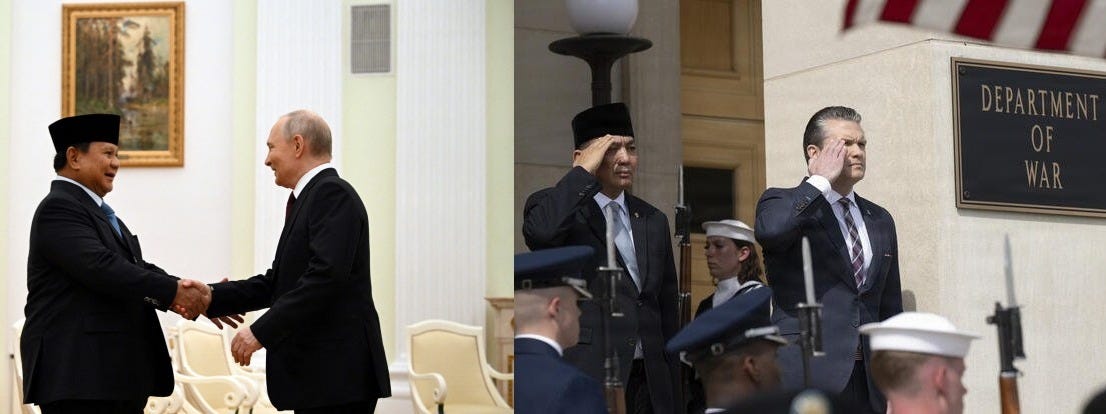
The same week Indonesia signed a major defence cooperation partnership with the US at the Pentagon, its president sat with Vladimir Putin at the Kremlin for 5 hours negotiating Russian oil. That is the Indonesian story in a single photo. Not multi-alignment. Not strategic hedging. The war on Iran has made all of its contradictions visible at once.
On 13 April 2026, the US and Indonesia formalised the Major Defense Cooperation Partnership at the Pentagon. It covers military modernisation, joint exercises in maritime and subsurface domains, autonomous weapons co-development, and expanded special forces training. Washington is simultaneously seeking blanket overflight access for US military aircraft through Indonesian airspace, giving the US direct surveillance capability over the Strait of Malacca, the world’s busiest chokepoint for oil and petroleum liquids. Jakarta says the proposal is still under review. Multiple Indonesian outlets reported that Prabowo had already approved it.
On the same day, Prabowo was in Moscow. He spent 2 hours in bilateral talks and 3 hours alone with Putin. The outcome was a long-term energy and mineral resources cooperation agreement, covering oil and gas supply, downstream processing, and what Jakarta now frames as energy resilience. Russia has received a formal request from Indonesia for oil product supplies. Prabowo told Putin he had come to “consult” because “the global geopolitical situation is evolving and changing very rapidly.” This is the 5th meeting between the 2 leaders in a single year.
From Moscow, Prabowo flew directly to Paris to meet Macron. The 3 meetings in 72 hours tell you everything about where Indonesia is and where it is not. It is everywhere. It is anchored nowhere.
Buying everything, choosing nothing
The military procurement alone reveals the depth of the contradiction. Indonesia is now acquiring or has committed to 42 Rafales from France, 48 5th-generation KAAN stealth fighters from Turkey, 42 J-10s from China, 16 KF-21 Boramae from South Korea, and has a freshly signed defence partnership with the US covering autonomous systems and next-generation technologies. That is 5 fighter platforms from 5 countries across 4 geopolitical blocs, with zero interoperability between any of them. The finance ministry cleared $3.1 billion in foreign loans for Chinese military equipment alone, including CM-302 coastal anti-ship missiles. The defence budget for 2026 is 187.1 trillion rupiah.
This is not diversification. Diversification implies a strategic logic where different suppliers reduce dependency on any one of them. What Indonesia is doing is accumulating bilateral defence relationships as political signals to each partner, without a unifying operational concept. The J-10 deal signals to Beijing that Jakarta takes Chinese military technology seriously. The MDCP with Washington signals that Jakarta remains inside the US security architecture. The Rafale signals European sophistication. The KAAN signals solidarity with Turkey and the emerging non-Western defence industrial base. Each deal makes sense on its own. Together they describe a country that has not decided whether it is a US security partner, a Chinese economic client, a BRICS strategic actor, or a non-aligned middle power. It is currently all 4 simultaneously. The war has made that position untenable.
The Hormuz shock and the scramble for oil
The closure of the Strait of Hormuz since 28 February has exposed Indonesia’s most dangerous structural weakness. The country is a net oil importer with 20 days of domestic reserves. Around 25% of its crude imports transit through Hormuz. Over 50% of the world’s nickel is produced in Indonesia, and 75% of the sulphur required for nickel processing comes from the Middle East through the same waterway. When Iran shut the strait, Indonesia lost access not just to fuel but to the chemical inputs that sustain its most strategically valuable export commodity.