

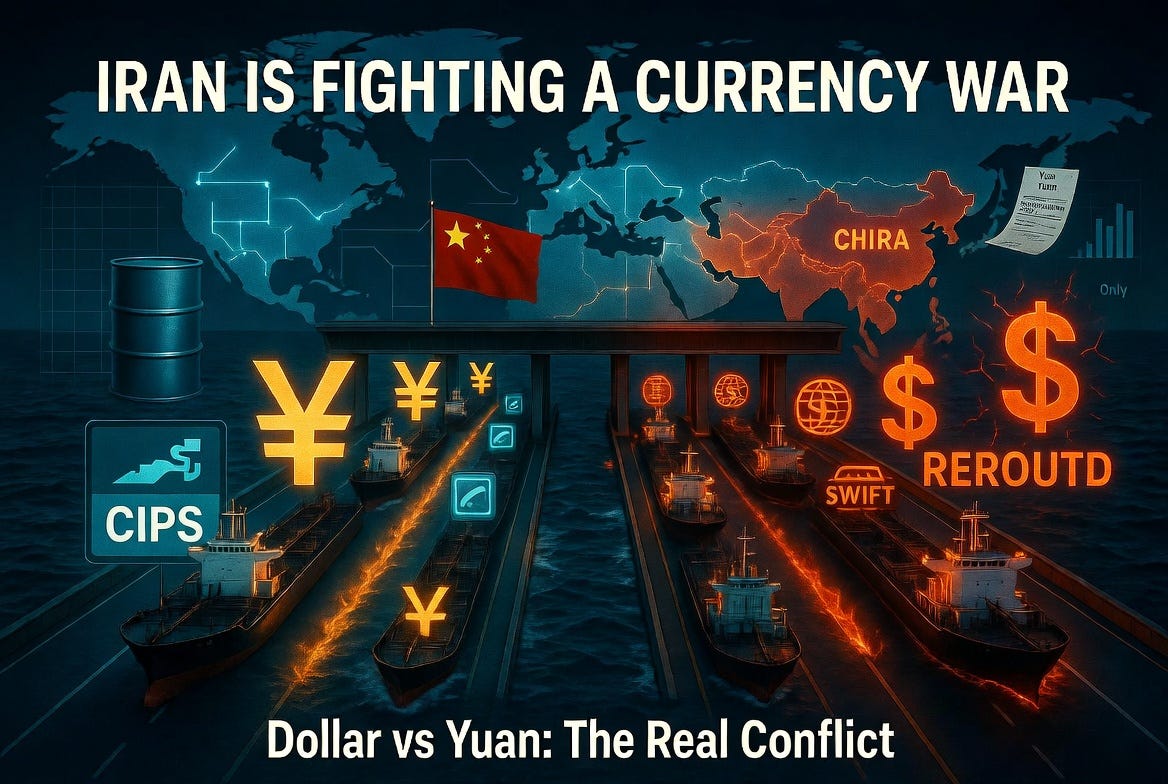
The war on Iran is not primarily about regime change, nuclear weapons, or regional stability. It is a currency war. The question at the centre of this conflict is whether the dollar or the yuan will invoice global trade for the next generation. Everything else is theatre around that structural contest.
When Operation Epic Fury launched on 28 February, Iran had already built something Washington could not tolerate. In January 2025, Tehran and Moscow signed a 20-year comprehensive strategic partnership treaty that formalised the elimination of the dollar from bilateral trade. By late 2025, over 80% of Iran-Russia trade was conducted in rials and roubles. Iran, China, and Russia signed a trilateral strategic pact in January 2026 explicitly designed to bypass SWIFT and construct alternative financial mechanisms. The infrastructure was operational before a single bomb fell. This was not hypothetical dedollarisation. It was a functioning parallel financial architecture.
The US did the same thing in Venezuela weeks earlier. Caracas had been selling the vast majority of its heavy crude to China in yuan and had joined BRICS-adjacent payment channels to circumvent the dollar. On 3 January 2026, Washington invaded, extracted the president, and immediately redirected Venezuelan oil sales back into dollar-denominated channels. The pattern is unmistakable. States that dedollarise their energy exports face military intervention. Iraq did it in 2000 with euros. Libya attempted it. Venezuela did it with yuan. Iran built the most advanced non-dollar energy payment system on earth and now finds itself under the largest sustained aerial bombardment since 2003.
The yuan corridor through Hormuz
Iran’s most consequential move has not been military. Since the closure of the Strait of Hormuz in early March 2026, Tehran has offered selective passage to tankers on one condition. Oil cargo must be invoiced in Chinese yuan. At least 2 vessels have already settled transit fees in yuan through a Chinese maritime intermediary. The fee structure is roughly $1 per barrel, meaning a single VLCC passage generates nearly $2 million in yuan-denominated revenue. Iran is also accepting stablecoin cryptocurrency payments, building a parallel digital settlement layer alongside the yuan channel with access to dollars.
This transforms the Strait from a shipping lane into a currency tollbooth. The practical consequence is a bifurcated global oil market. Yuan-denominated barrels flowing through Hormuz via China’s Cross-Border Interbank Payment System and dollar-denominated barrels rerouted at vastly higher cost for those refusing to settle in Chinese currency. Approximately 20% of global oil and gas shipments transited Hormuz in peacetime. That volume is now held hostage to a currency denomination question. The war premium that Western energy importers are absorbing is no longer temporary. It is becoming structural.
Iran chose the yuan deliberately. It did not demand roubles, despite the depth of its partnership with Russia, because Iran’s greatest trade deficit is with China. Beijing purchases the vast majority of Iranian oil exports and has done so for over a decade, settling in yuan since at least 2012. The rouble would have been geopolitically symbolic but economically useless for Tehran. Iran needs a currency it can spend, and it spends overwhelmingly in the Chinese economy. The yuan is not just a protest currency for Iran. It is the functional medium of its commercial survival.
The rouble, by contrast, is what Russia uses for its own purposes. Moscow internationalised rouble usage after the 2022 Ukraine war, pushing bilateral settlements in roubles with India, Turkey, and across Central Asia. But the Ukraine war also triggered a wave of redollarisation as frightened capital flooded back into dollar assets for safety. The dollar index surged. Treasury demand spiked. The same paradox is now playing out with Iran. The dollar index broke through to 2026 highs in the war’s opening weeks, testing 99.50, because energy importers worldwide scrambled to acquire dollars to pay for expensive crude. The short-term effect of every dedollarisation war is to strengthen the dollar temporarily while weakening it structurally.
Who profits in Washington
The domestic US political economy of this war is rarely discussed, but it matters enormously. The war is costing approximately $900 million per day in military operations. US national debt reached $39.01 trillion on 26 March 2026, growing by roughly $1 trillion every 100 days. Annual interest payments now exceed $1 trillion, surpassing the entire pre-war defence budget. The administration has proposed raising the 2027 defence budget to $1.5 trillion. All of this requires continued global demand for the dollar and for US Treasury securities.