

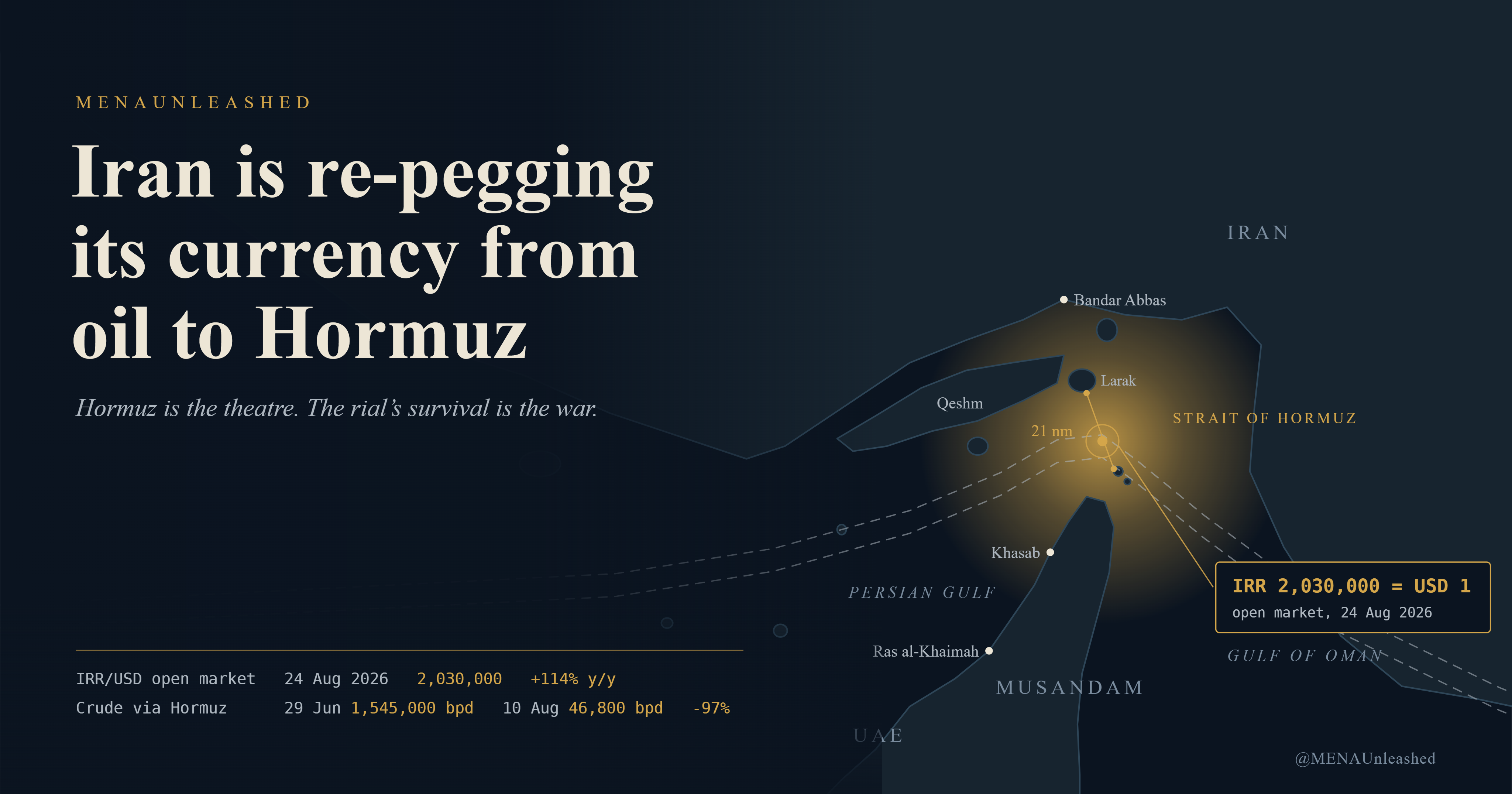
On 24 August the rial crossed 2 million to the dollar on Tehran’s open market, 203,000 tomans by mid-afternoon and up 114% in 12 months. The same day the US Treasury launched Operation Economic Outcast, nearly 60 new designations, secondary sanctions extended to gold, digital assets, technology, aviation and shipping, and a warning that no country still buying from Tehran sits beyond its reach. The UAE had halted all trade and financial transactions with Iran the week before. The 60 day memorandum signed in Islamabad had expired on 17 August with the blockade back, the oil waiver revoked and no frozen funds released. And parliament’s security commission had just approved a bill charging service fees to every ship transiting Hormuz and barring the vessels of any state that has frozen Iranian assets. Six months into this war the commentary is still about lanes, mines, toll booths and who owns the water.
However, the fee bill should not be read as maritime policy. It is monetary policy. The rial has no backing left. Oil exports are almost zero, gold is the one reserve Tehran has been building and gold is now sanctionable, the dollar is closed and the yuan is a currency of discounts, not liquidity. So the state has done what a state with a collapsing currency and no reserve asset does. It has tethered the rial to the one asset no bombing campaign can remove, its geography. The Saudi riyal holds because it is structurally tied to dollar oil. The rial is now structurally tied to the claim that nothing moves through 21 miles of water without Tehran’s consent. Hormuz is a geopolitical reserve for a currency that has none, and a trust booster for a society that needs to believe the state still has something to fight with and for.
The real fight is at the currency level, and the regime cannot explain exchange rate arbitrage and general licences to a public earning $83 a month. So it tells them the war is about the strait. In reality, it is about access to dollars and to shipping lanes, and Iran has now lost both.
Financial damage can be arbitraged. Physical damage cannot
Since 1988 every sanctions regime has been a financial siege around a physical plant that kept working, and Iran survived by turning the siege into a business. The multiple exchange rate was the core of it. The state imported at a preferential rate, the market sold at the free rate, and the networks that controlled allocation, most of them tied to the Revolutionary Guards and their foundations, captured the spread. Rice imported at 28,500 tomans to the dollar was meant to reach households at 60,000 tomans a kilo and reached them at 150,000. Officially there was no dual rate. De facto the dual rate was the sanctions economy, and households paid the premium for the state’s survival, which is why the base wage has fallen from $232 a month a decade ago to $83, below the $10 a day line that marks risk of hunger. The preferential rate was abolished on 4 January and replaced with ration vouchers that now buy a third of what they did. The spread simply moved. The central bank’s transfer rate is 157,200 tomans against 203,000 on the street, a 29% gap that is still somebody’s margin.
What the war added is damage no exchange rate can absorb. The 18 March strike on Asaluyeh took out roughly 100 million cubic metres a day of processing at a field that supplies 73% of national gas, feeds 65% of petrochemicals and fuels around 60% of the power fleet. The utilities complex at Mahshahr that fed gas, electricity and industrial water to more than 50 downstream plants was knocked out on 4 April, a 2 year rebuild by the oil ministry’s own estimate. Khuzestan Steel shut and Isfahan’s mills were hit, removing about half of a 32 million tonne industry. Replacement cost is put at $91 billion, total damage at $144 billion or roughly 40% of pre-war GDP, and the government’s own preliminary figure is $270 billion, about 90% of this year’s GDP, with reconstruction measured in decades. The IMF has output at -5.4% this year with inflation at 68.9%. The central bank’s own August print shows point to point inflation at 84.4% and goods inflation at 121.5%.