

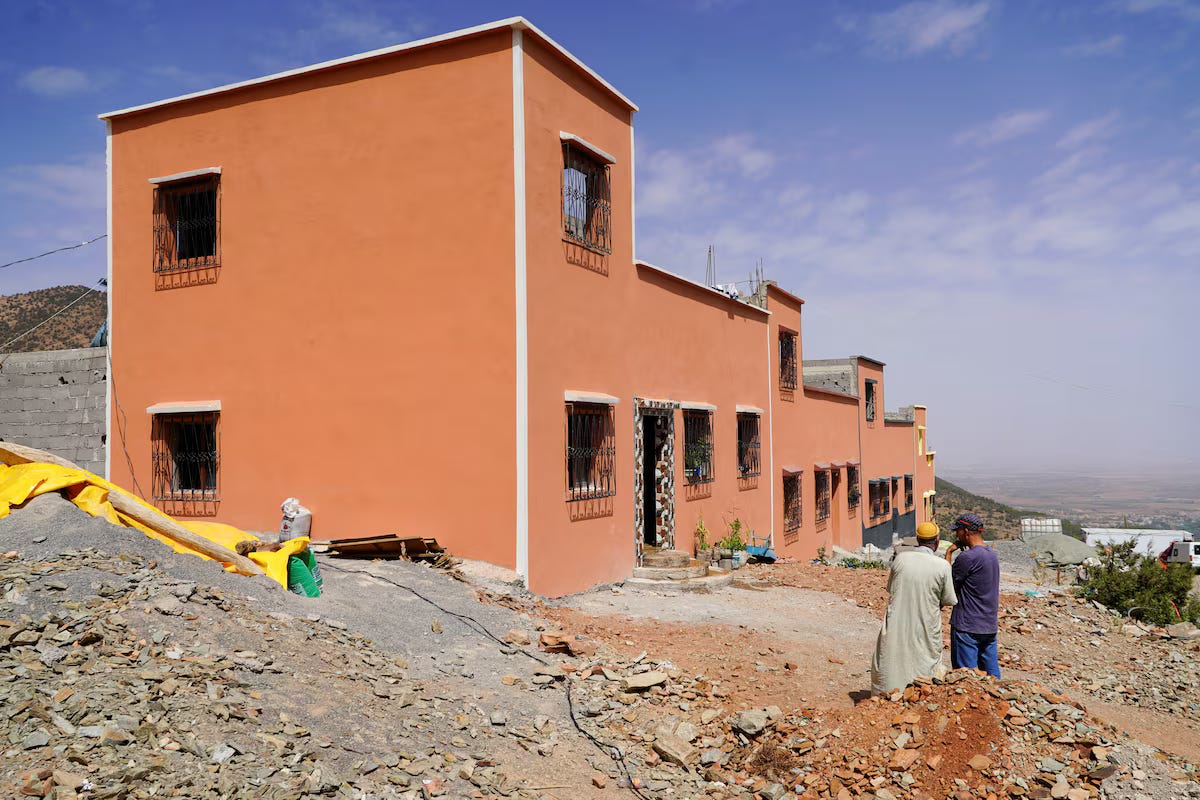
On 5 June 2026, the European Investment Bank released a further 500 million euros for Morocco, completing a billion-euro commitment to the High Atlas towns wrecked by the 2023 earthquake. Recovery efforts will include rebuilding roads, schools, clinics and others.
The new loan tranch extends an approach the palace has spent 15 years refining which seeks the conversion of outside dependency into domestic control as the region is ravaged with the Strait of Hormuz crisis consequences.
Morocco is not a kingdom quietly rebuilding, and not a logistics hub lucky to sit beside a war, but a monarchy that has learned to turn its own contradictions into leverage to stabilise the regime.
In this approach, Europe lends, Washington recognises, the Gulf reassures, China builds, Moscow abstains rather than blocks, and a burning region keeps routing capital, cargo and migrants through the government that still looks calm.
The war on Iran expedited the process. When US and Israeli strikes hit Iran on 28 February 2026 and Tehran answered by closing the Strait of Hormuz, the Gulf turned overnight from a key corridor into a target. Tanger Med, which moved 11.1 million containers and 161 million tonnes in 2025, suddenly presented itself not as a periphery but as the route that still works.
Fortunately, Morocco is more stable than almost all countries around it. It is not Egypt, where every external shock passes straight through the Suez Canal, the currency and imported fuel. It is not Jordan, boxed in by aid dependency, refugees and a war on its doorstep. It is not Saudi Arabia, whose own transformation is now lashed to enormous state spending and mounting financial strain.
However, whilst the advantage is real, the danger is to read that stability as regime health. Morocco is not strong because its social contract delivers. It is strong because the actors around it need its contradictions managed by the palace, and normalisation with Israel requires cementing the King rule.
When private credit stopped paying
The 2011 uprisings forced the monarchy to answer demands for work, services, dignity and accountability, and it survived through constitutional cosmetics, party management, a controlled political opening and tight fiscal discipline. It did not collapse, and it did not become a liberal market. Across the following decade the state quietly rebuilt its central role inside the economy while keeping the language of private enterprise intact.