

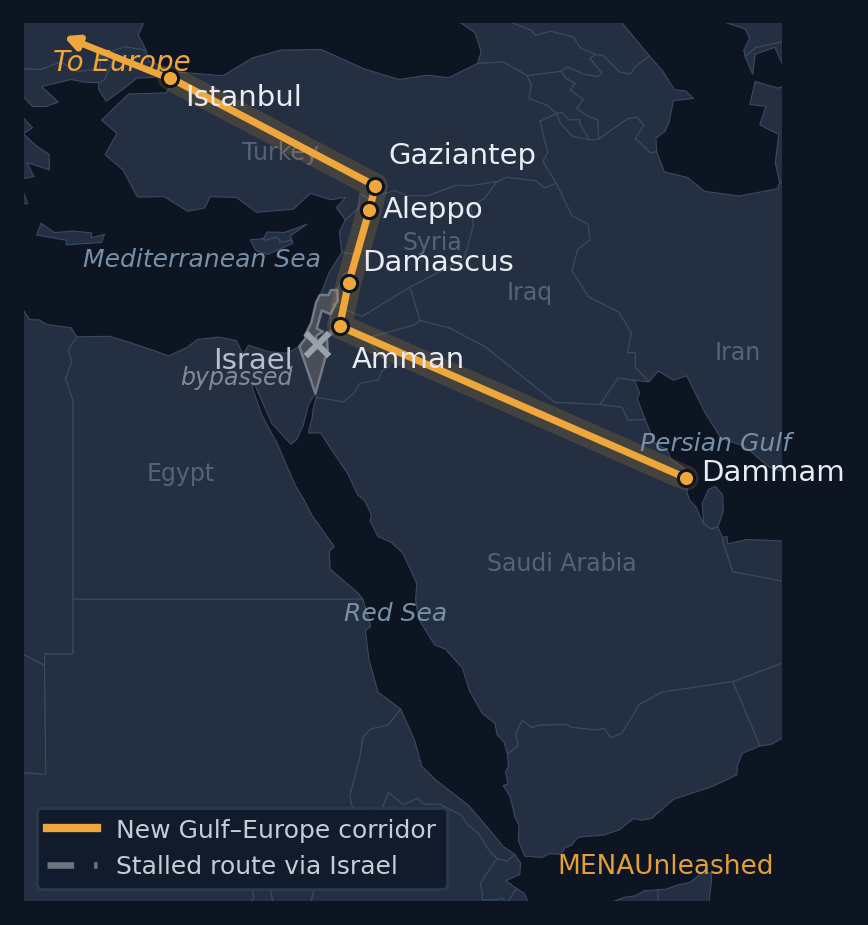
The lifting of Riyadh’s 5-year ban on Lebanese exports on 10 June was read across the region as a thaw, a gesture to a weakened Beirut. However, upon closer examination, it is nothing of the sort. It is the reactivation of a northern trade artery that runs through the Levant and Anatolia and never touches an Israeli port, and it is one move in a far larger design. Saudi Arabia is not delaying its entry into an Israeli-centred regional order. It is constructing a Saudi-centred one that functions without Israel at all. Syria may pay the price, yet again.
The infrastructure of a bypass
The Saudi turn is physical this time, not rhetorical. In late March, the national railway opened a freight corridor of more than 1,700 km linking the eastern ports of Dammam and Jubail to the Al-Haditha crossing on the Jordanian frontier, each train moving upward of 400 containers and halving the transit times of road haulage. It was launched as an explicit land alternative to the Strait of Hormuz, one element of a programme pulling cargo off the Gulf coast and feeding it across the peninsula to the Red Sea terminals at Jeddah and Yanbu. On 9 June, two memoranda with Ankara extended the logic northward, sketching an overland spine from the kingdom through Jordan and Syria into Turkey and on to Europe. The Saudi link to the Jordanian border already exists. The Turkish line already reaches the Syrian frontier. The missing pieces are a 400 km gap between Syria and Jordan, and a section between Turkey and Aleppo that Ankara will rebuild for around 100 million dollars, opening a direct line to Damascus. Test runs from Turkey through Iraq to the kingdom have proved the route. Other Gulf states have been invited to fold in behind it.
This is the revival of the Ottoman Hejaz line, inaugurated in 1908, running from Istanbul to Medina through Damascus and Amman, abandoned after the First World War and never rebuilt after the plans collapsed in the wake of the 1967 war. Its return is not nostalgia. The corridor from Aqaba through Amman, Damascus and Aleppo into Anatolia performs two functions at once. It bypasses Hormuz, and it bypasses Israel. Neither its Saudi backers nor its Turkish builders have disguised the second purpose. The route is engineered to strip Israel of any indispensable role in the movement of regional trade, and its proponents have framed it as the killing of the IMEC 2023 corridor that was meant to bind India to Europe with Israel as the hinge.
The redundancy Israel cannot offer
That earlier corridor, the India to Middle East to Europe route announced at the 2023 G20 summit, rested on Saudi-Israeli normalisation and on a northern leg carrying Gulf freight through Jordan into Israeli Mediterranean ports. It is now a memorandum without a road. It carries a financing gap of roughly 5 billion dollars, no construction timeline, and a political foundation that has dissolved. Coalition politics inside Israel stalled the rail through Israeli territory, and 99% of Saudis polled this year reject normalisation.
Israeli leadership has spent the war pressing the opposite geography, pipelines and routes carrying Gulf oil and gas west across the peninsula to Israeli ports, with Israel positioned as both commercial hub and the guarantor against any closure of Hormuz. The proposition turned out to be empty and Israel is not able to offer much. Instead, for example, the East-West pipeline, 1,200 km from the eastern fields to Yanbu, which was laid in the 1980s for precisely this contingency, has exported a record 7 million barrels a day, pushing roughly 5 million out through the Red Sea while Hormuz stood closed. On the energy map, as on the freight map, Israel supplies nothing the kingdom cannot secure without it.
This is what the Saudi-Turkish track is really carrying, and it is not a formal pact to strangle Israel. The two states are not even doing the same thing. Ankara runs an open embargo, having severed direct trade in 2024, with the official tally at zero since the middle of that year, even as goods still reach Israel through third-country rerouting. Riyadh’s method is quieter and more durable. It is not boycotting Israel at all. It is building a map on which Israel is no longer a necessary node, and a structure that routes around a state outlasts any embargo that merely punishes it.
Neither state is working alone. The corridor is only the visible edge of a wider realignment, one built on a shared refusal to be subordinate to Israel or to let it dictate the region’s terms. That instinct has pulled Cairo and Islamabad in alongside Ankara and Riyadh, and their foreign ministers met repeatedly across the spring, in Riyadh in March, in Islamabad later that month, and in Antalya in April. On paper the grouping is heavy. It joins around 500 million people and a spread of assets no rival can match in combination, Turkish industry and ports, Saudi capital and crude, Egyptian command of Suez, and Pakistani strategic depth, the last of which brokered the current understanding between Washington and Tehran. Yet it is not an alliance and binds no one in law. It is a convergence of corridor politics and shared interest, broad in reach and thin in obligation.