

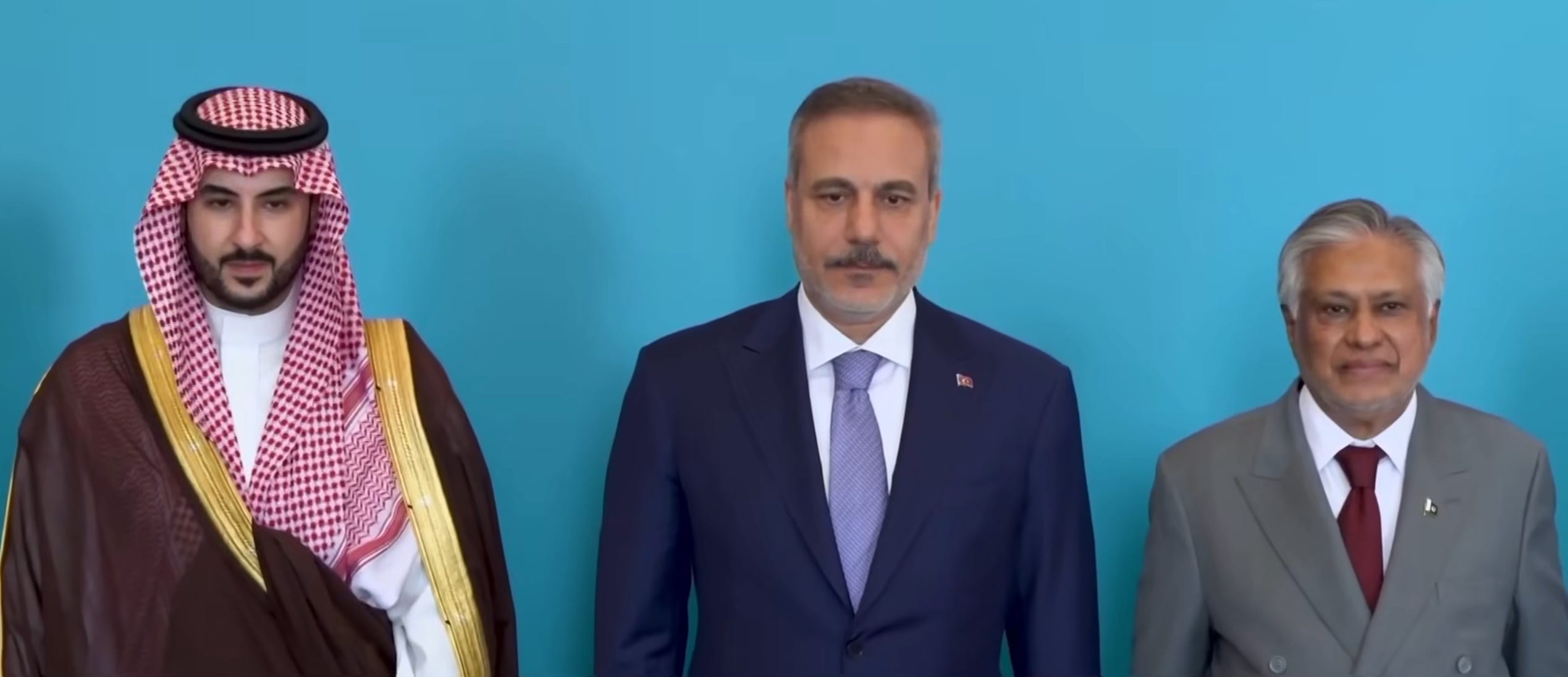
Less than a month after the Saudi crown prince, the Turkish president and the Pakistani prime minister stood in Mecca on 7 August 2026 and signed a treaty declaring that an armed attack on any one of them is an attack on all three, the pact has a name, an address and a division of labour. On 31 August the foreign ministers, defence ministers and chiefs of staff of the three states met in Istanbul for the first session of the Strategic Political and Defence Committee created under the treaty, adopted Mecca Defence Alliance as its official title, agreed a permanent secretariat in Riyadh and gave Pakistan the first secretary general post for a 3 year term. The joint statement committed the three to strengthening their armed forces through joint activities, defence industry cooperation and the joint development and production of military technology, and described a structure built to expand.
Most coverage filed both the treaty and its institutional follow up under security. That is a category error. The Mecca Defence Alliance is not primarily a security story. It is the moment a commercial empire acquired a borrowed army, and the clearest signal yet that the Middle East has entered a phase best understood as a collision of emerging capitalist empires.
Over the past 50 years these states became rich. Unevenly, with brutal internal inequality, but rich in the aggregate, sitting on accumulated capital that must now be recycled, grown and defended. For decades the recycling circuit ran through the West. Petrodollars went into US Treasuries, London property, European banks and American arms contracts, and the surplus came back as protection. That circuit is degrading. Europe is stagnant and cannot absorb the volumes. The US weaponises finance, extracts tribute and no longer behaves like a reliable custodian of anyone else’s savings. When the external outlet narrows, surplus capital does what it has always done. It builds itself a hinterland. What looks like regional chaos is competing accumulation regimes each trying to construct one, on overlapping territory, at the same time.
Too much capital, nowhere to go
Each emerging project runs on a different mix of assets, and none holds the full kit. Iran stakes two claims at once, custodianship of regional Shiism and the memory of Persian empire. The second claim is written into the water itself. Hormuz carries the name of Sasanian kings, and when Tehran shut the strait in March it was asserting inheritance as much as leverage, a statement that the waterway between the plateau and the peninsula answers to Persia.