
The Clash of Corridors: Saudi and UAE at a Crossroads (with maps)
IMEC died at its Israeli end. Saudi Arabia and the UAE now race to build rival corridors, each cornered by volume, Iran, and Israel.

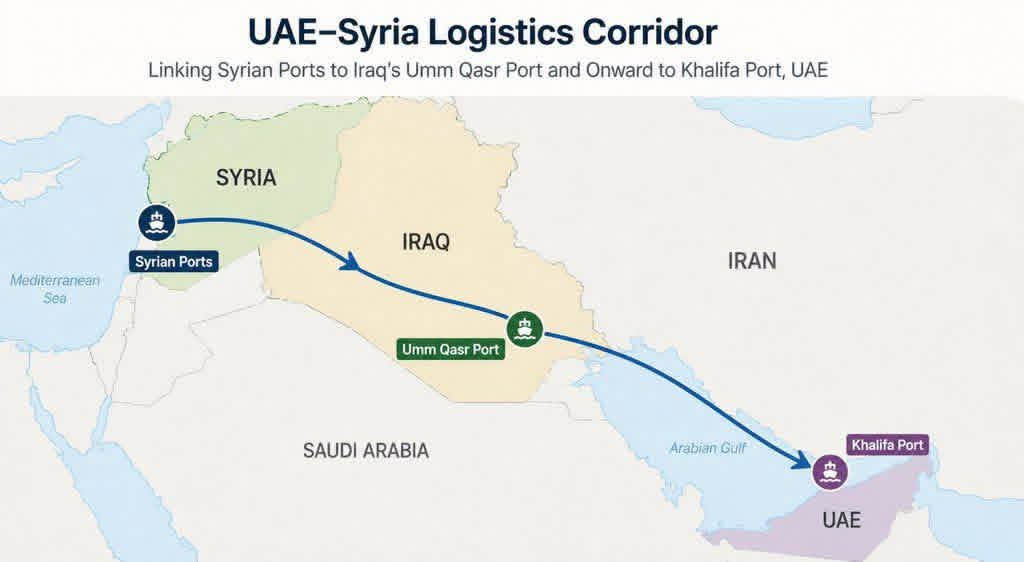
In the past week, the UAE has sketched a trade route from the Syrian coast through Iraq to its own Gulf ports, and quietly restored direct shipping to Iran. Both moves belong to the same scramble. The corridor the Gulf actually signed up to, the grand rail and shipping line meant to carry Indian goods to Europe through the Arabian Peninsula and out of the port of Haifa, is finished, and the states that staked a decade of planning on it are now racing to build their own routes on the wreckage. What looks like infrastructure policy is a contest for regional primacy, fought between Riyadh and Abu Dhabi, and shadowed by Israeli power that can wreck whatever either of them builds.
The corridor that died
The India to Middle East to Europe corridor (IMEC), unveiled in 2023 as the West’s answer to China’s Belt and Road, was to run from Indian ports across the sea to the Emirates, overland by rail through Saudi Arabia and Jordan, and into Israel, where Haifa would serve as the gateway to the Mediterranean and on to Europe. Its foundation was the normalisation of Israel with the Gulf, the political settlement the Abraham Accords were meant to consummate. The corridor was never really about logistics. It was a wager that a Saudi-Israeli peace would knit the region into a single trade spine under American patronage, with Israel as its Mediterranean mouth.
The war took the wager apart. The Gaza campaign that began in 2023 froze the Israeli and Jordanian rail segment before a metre of it was laid, and by 2026 Saudi opinion against normalising with Israel stood at essentially 99%, which put the corridor’s political precondition beyond reach. Then the US-Israeli war on Iran degraded the Israeli end physically as well as politically. Israeli infrastructure spent the year under Iran and its allies missile and drone fire, the rail line meant to cross northern Jordan to Haifa became a target rather than a route, and the Gulf states drew the obvious lesson, that binding their trade to Israel meant binding it to the one country certain to be attacked. There was also the plain matter of size. Haifa moved around 1.5 million containers in 2024, a mid-tier Mediterranean port, nowhere near the scale the corridor’s promoters implied. Its backers still call the project paused. In practice, the war killed it, and everything now being built is being built in its place.
The rival maps
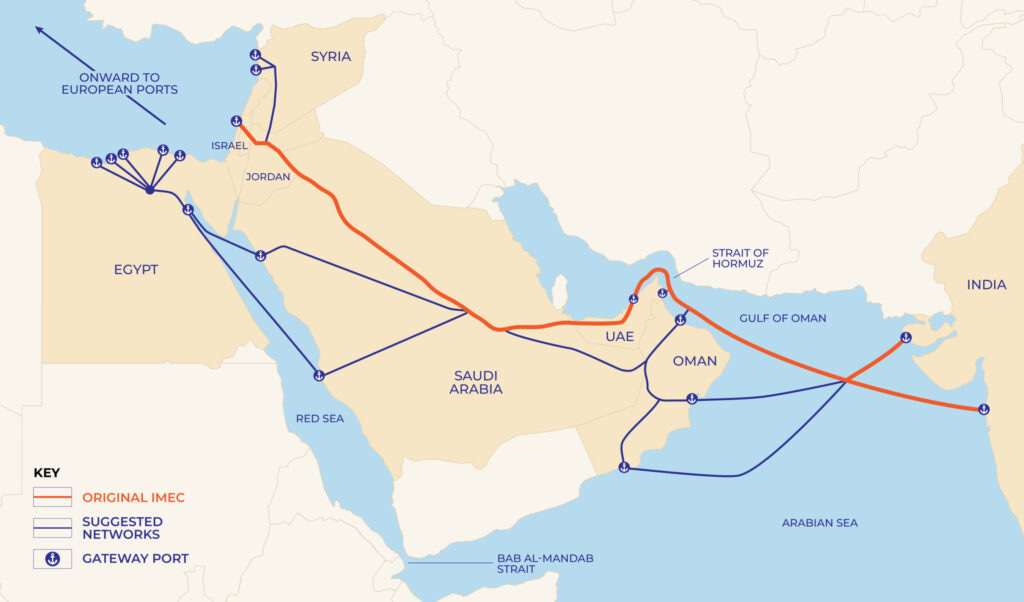
With the shared route gone, the two Gulf powers have split toward rival solutions, and the split runs along the fault line that already divided them. Saudi Arabia’s answer is concentration.
Keep reading with a 7-day free trial
Subscribe to MENA Unleashed to keep reading this post and get 7 days of free access to the full post archives.