

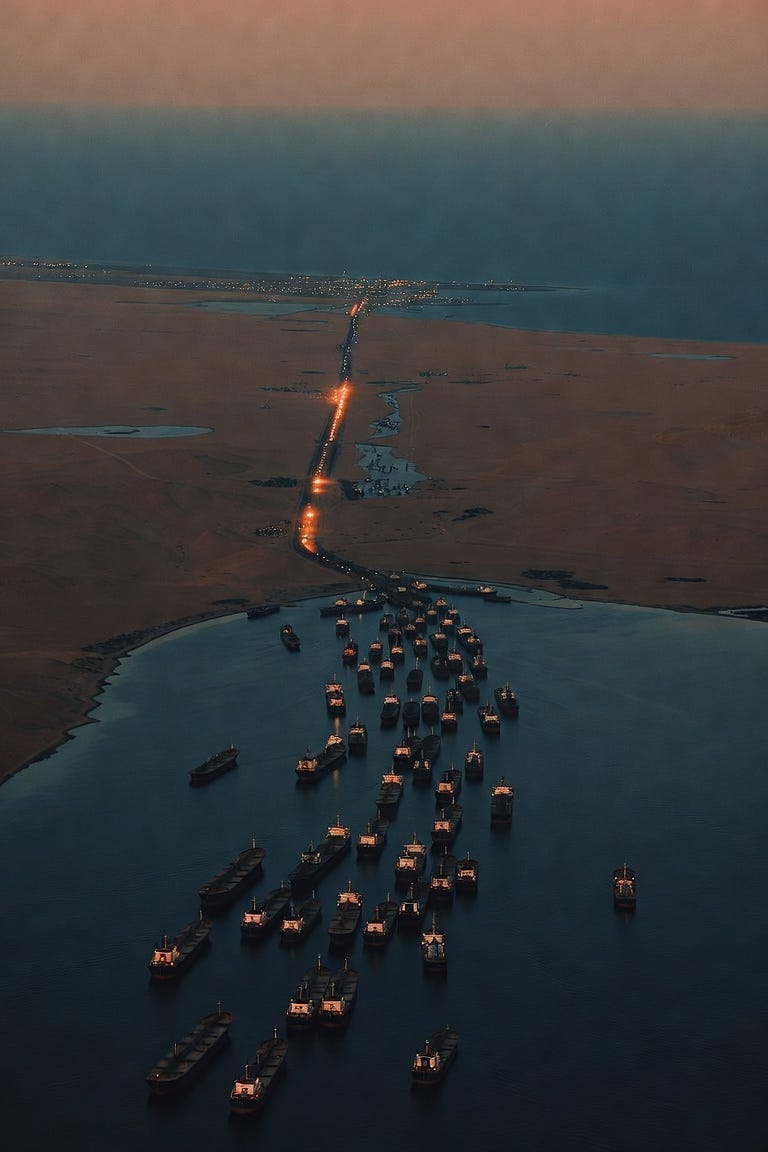
A country does not sign away half a century on a whim. When UAE state owned DP World committed in late July to a 50-year concession for two deepwater terminals on the UAE’s Gulf of Oman coast, it was not making a bet on Fujairah. It was making a bet against the Strait of Hormuz, and against the premise that has underwritten Emirati prosperity for two generations, that oil, gas, containers and capital can always find their way out through the 21 miles of water separating Iran from Oman. That premise died on 28 February, when US and Israeli strikes killed Iran’s supreme leader and Tehran answered by closing the strait through which around 20% of the world’s oil normally moves. Everything Abu Dhabi has done since has been an attempt to live without it, and the attempt has become the organising project of the state.
The shock was severe enough to justify the scramble. Container traffic through Jebel Ali, the busiest box port in the Gulf and the commercial heart of Dubai, has fallen by roughly 95%. War-risk premiums that sat at 0.25% of a vessel’s value before the war have climbed to between 3% and 10%, turning a routine transit for a $100 million tanker into a toll of $3 million to $10 million. Around 6,000 seafarers have been stranded in Gulf waters. In July two Emirati supertankers were struck by cruise missiles inside the strait, killing a crew member and injuring 8. The mainstream reads the Emirati response as prudent resilience-building. It is better understood as flight, and the flight is stranger than it looks, because the same state that is spending billions to move its exports and its treasury out of Iran’s reach is spending as much again to persuade everyone else’s money to stay inside it.
Building a second coastline
What is under way is not a set of discrete infrastructure projects but the reorientation of an entire political economy around a single geographic problem, executed through the instruments the state actually controls. ADNOC, DP World, Mubadala and Etihad Rail are not private firms responding to a market signal. They are arms of the state, and their simultaneous mobilisation is the clearest expression of how the UAE governs, through the balance sheets of sovereign vehicles directed from the top. The organising doctrine has a name now. The foreign trade ministry has declared that the country is moving towards zero Hormuz dependency regardless of whether the strait is open or closed, and that the plan will not stop even if traffic resumes. That is not contingency language. It is a decision to treat the strait as permanently unreliable and to rebuild the country’s outlets accordingly.
On the energy side the spine of the effort is the Abu Dhabi Crude Oil Pipeline, which has carried crude from the Habshan fields overland to Fujairah since 2012 at up to 1.8 million barrels a day. During the blockade it has been the difference between the UAE, which kept exporting at reduced volume, and Kuwait, whose seaborne crude simply stopped. Abu Dhabi is now fast-tracking a second west-east line, a project once costed at around $3 billion, to roughly double bypass capacity to 3.6 million barrels a day by 2027. DP World’s new terminals extend the same logic to cargo, lifting the group’s UAE box capacity from 19.4 million to nearly 22 million containers a year and letting freight enter and leave the country without touching Hormuz before moving overland to Dubai, Abu Dhabi and the wider Gulf. The plan reaches beyond Fujairah to Khor Fakkan, Dibba and at least one entirely new harbour on the Gulf of Oman, stitched together by Etihad Rail’s 900 kilometre freight spine from the Saudi border to the east coast, capable of moving up to 60 million tonnes a year, and by the 238 kilometre line being built to connect Abu Dhabi’s industrial belt to the Omani port of Sohar. The ambition is a second entrance to the country that does not depend on the sea lane every rival approach must use.
The trouble is that the escape is partial by design, and the parts that cannot escape are the ones that matter most. Crude can be piped around Hormuz. Liquefied natural gas cannot. The flagship Ruwais gas project, nearly fully booked ahead of its 2028 start and pitched as the country’s entry into the global gas trade, sits on the Gulf coast inside the strait, as does the refined-product output of the Ruwais refining complex. The pipeline solves the problem for the one export that can travel by land and leaves the higher-value molecules where they have always been, hostage to the tanker route. Even the crude bypass is a fraction of what is needed. Against the 17 to 20 million barrels a day that crossed Hormuz before the war, a doubled pipeline moving 3.6 million barrels replaces a slice, not the whole. And geography compounds the ceiling. Fujairah lies around 80 miles from the strait, comfortably inside the range of the drones and cruise missiles Iran has been firing all year, and the port has been hit repeatedly, its oil zone set alight more than once. A bypass that is itself a target is a hedge, not an exit.