

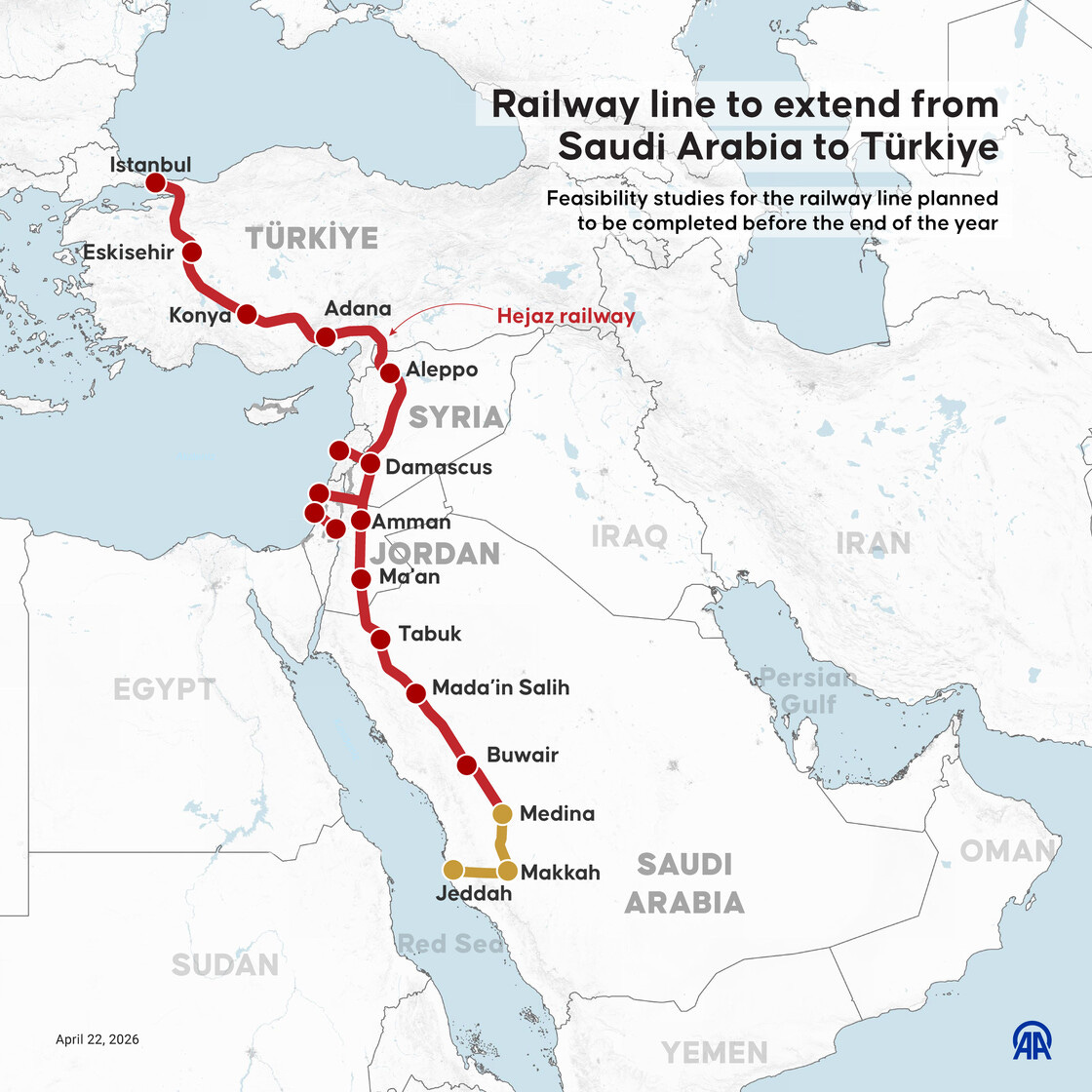
In Riyadh on Tuesday, Turkey and Saudi Arabia signed 2 memorandums of understanding on railways and logistics, formally bringing the kingdom into the revival of the Hejaz railway after Syria. The Ottoman original, built from 1900 with donations gathered across the Muslim world, ran from Damascus to Medina and carried a branch line down to Haifa. The modern version goes through Aleppo, Damascus and Amman. Feasibility studies are due before the end of this year, construction is scheduled from 2027, and 2 trial transit runs have already moved from Turkey through Iraq to Saudi Arabia along the Development Road from Faw Port. Unlike with the India-Middle East-Europe Economic Corridor (IMEC), nobody has drawn a branch line to Haifa this time. Turkey has said an extension to Haifa can occur only after the establishment of a Palestinian state and respect for the rights of the Palestinian people. Slowly, Israel turned from the centre of a regional trade hub geopolitics and geoeconomics into an outcast threatening the whole premise of the Abraham Accords and the IMEC regional integration plan centred around it. Through weaponised interdependence, Israel sought to undermine Iran and lock in Arab normalisation, but the Iran war showed the limits of Israeli aspirations and kicked off the marathon for the new regional order.
Israel’s short-lived edge
Israel and the UAE share a structural problem. Both are small against their neighbours in population, territory and depth, and both answered this dilemma the same way, by making themselves network nodes that bigger states could not route around. The academic literature calls this weaponised interdependence. Networks of finance, data, shipping and energy are hierarchical. They concentrate around a few hubs, and a state controlling a hub sees everything moving through it and can cut it off whenever it suits them, making connectivity a leverage.