

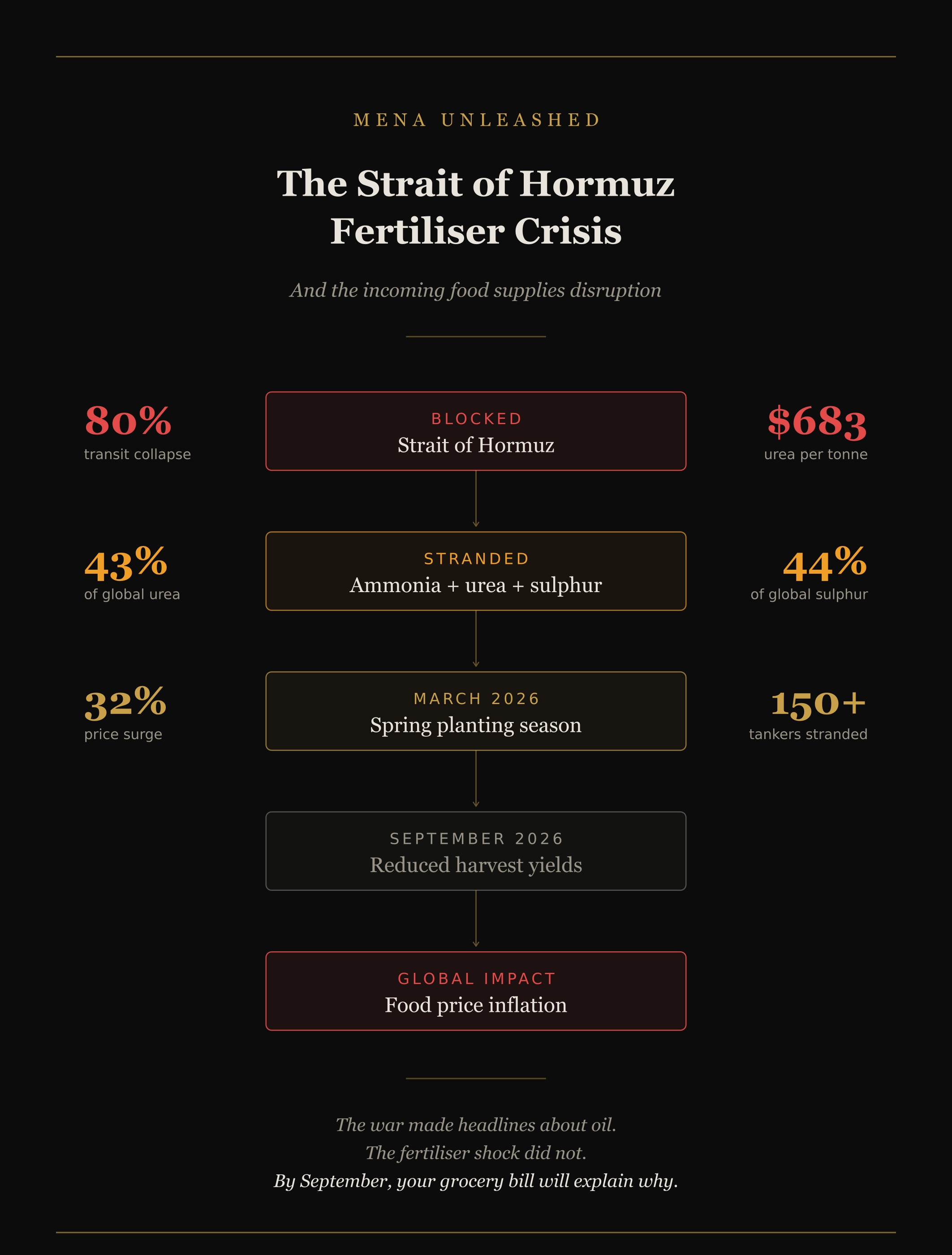
Three weeks into the effective closure of the Strait of Hormuz, global urea prices have surged by more than 30%, nearly 1 million metric tonnes of fertiliser cargo sit stranded in the Persian Gulf, and major producers across the region have declared force majeure on deliveries to Asia, South America, and Africa. The crisis that will define the rest of 2026 is not the one on every screen. It is not the oil shock, though Brent crude has broken $105 a barrel. It is a fertiliser shock, arriving at the precise moment that farmers across the Northern Hemisphere are entering spring planting season, the narrow window that determines what the world eats in September. The chain runs from Hormuz to ammonia to urea to the planting calendar to the autumn harvest to the grocery shelf. It is long, lagged, and almost entirely absent from mainstream coverage. By the time prices arrive at the supermarket, the cause will have been forgotten. This article traces that chain.
The Gulf accounts for approximately 43% of the world’s seaborne urea exports, 44% of global sulphur trade, and more than a quarter of internationally traded ammonia. These are not marginal shares. They represent structural dependence. Urea is the most widely used solid fertiliser on earth, and its production begins with natural gas, which is converted into ammonia through the Haber-Bosch process and then into the nitrogen compounds that sustain roughly half of global agricultural output. The entire value chain runs through one waterway. When that waterway shuts, the disruption does not merely delay shipments. It breaks the production cycle itself.
How the Strait closed without a blockade
Iran did not mine the Strait of Hormuz. It issued radio warnings and launched drones at a handful of vessels. Within 24 hours of the first IRGC threats on 2 March, vessel traffic collapsed by over 80%. Just 7 ships crossed that day against a daily average of 79. More than 150 tankers are anchored outside the strait, fully loaded, going nowhere. No LNG carriers transited at all. The waterway is 21 miles wide, legally open to international navigation, and physically unobstructed. It is commercially dead.