

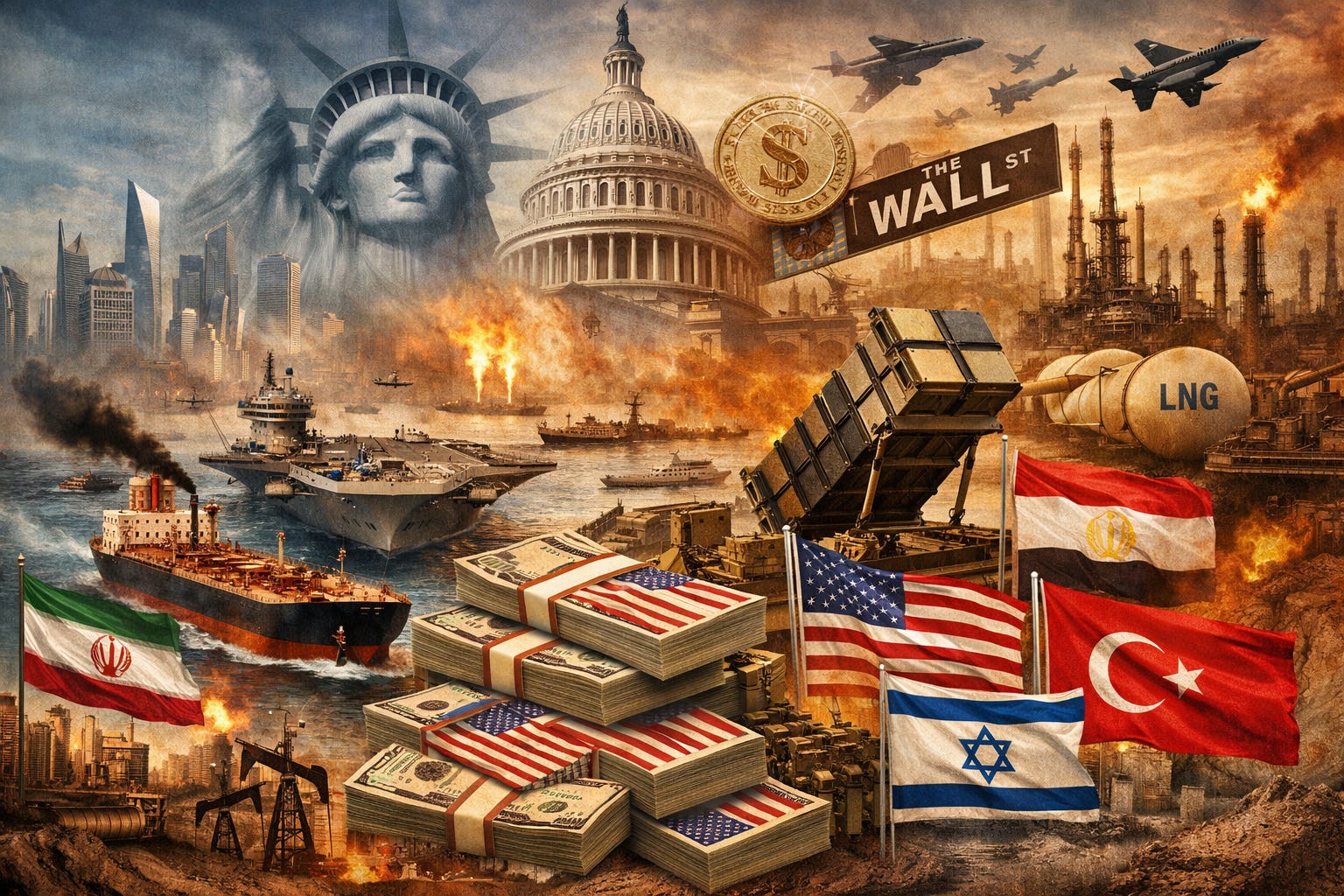
Two weeks into the bombing of Iran, the framing has already been set. Regime change. Nuclear disarmament. Regional stability. These are the terms offered to the public and they are, at best, a fraction of what is actually happening. The war launched on 28 February 2026 is not principally about replacing the Islamic Republic with something more amenable to Washington. It is about restructuring the political economy of the entire Middle East to deepen its financial subordination to the US. Every dimension of the conflict, from the Strait of Hormuz closure to the trillion-dollar investment pledges extracted from the Gulf, follows one logic. Washington is engineering dependencies that funnel capital, energy revenues, and strategic leverage back to the American economy at the precise moment that economy needs external inflows most desperately. Iran is the catalyst. The real targets are everybody else.
The pattern is not new. The war in Ukraine severed European energy dependence on Russia, collapsed European industrial competitiveness, and redirected both capital and corporate migration toward the US. American LNG exports to Europe surged. European defence budgets ballooned, with Germany alone now spending over $100 billion per year on arms, much of it procured from or in partnership with US firms. In January 2026, the US seized Venezuela, captured its president, and within days announced that American oil companies would invest billions to rebuild its shattered infrastructure. 70% of US refinery capacity is optimised for heavy crude of the kind Venezuela produces. The Venezuelan operation was not humanitarian intervention. It was industrial policy conducted through regime change to maintain US dollar and energy hegemony. The Iran war is the same model applied to the Middle East, and it is already producing the same results.
Buying Protection at American Prices
The Gulf states have been purchasing American weapons for decades. What is different now is the scale of dependency being imposed under conditions of live fire. In late January 2026, the US Defence Security Cooperation Agency notified Congress of a potential $9 billion sale of 730 Patriot PAC-3 MSE interceptors to Saudi Arabia. Kuwait received an $800 million Patriot sustainment package. Qatar, which has spent $47.9 billion on US arms since 2010, remains the single largest foreign investor in the American economy. Every interceptor fired at an incoming Iranian missile is another transaction in which American defence contractors profit and Gulf treasuries deplete.