

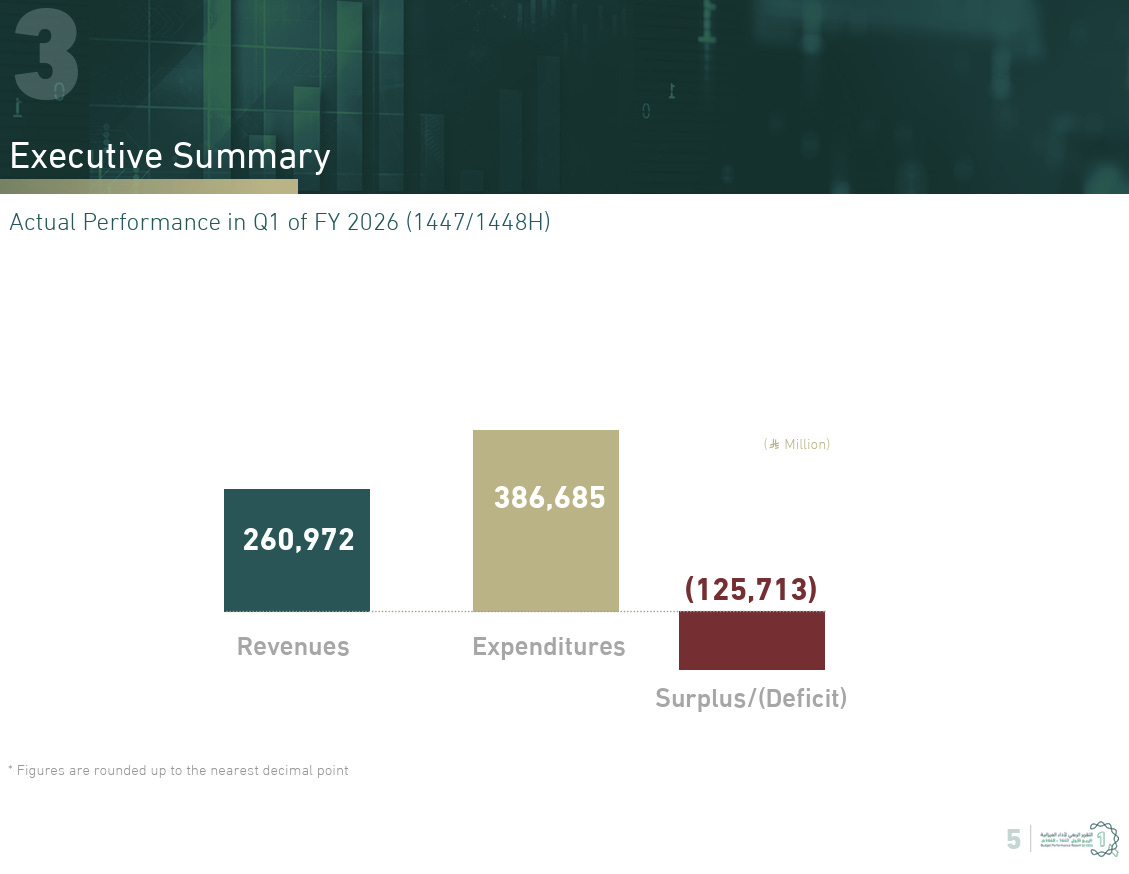
The Q1 2026 budget report records the moment Saudi Arabia structurally broke from the oil revenue model and crossed into a debt-financed deficit economy. The Iran war is the immediate trigger. The architecture was prepared for the transition before the first missile crossed Saudi airspace in February. The numbers describe a kingdom now permanently dependent on issuance for the spending the oil line can no longer fund, with a productive base damaged by war, and a fiscal arithmetic that does not return to balance under any horizon the budget can credibly model. The crossroad the regime is at is not whether to choose between austerity and growth. It is whether to acknowledge that the model has changed or to keep running the financialisation programme until the markets force the change.
The headline carries the case. Q1 revenue fell 1% year-on-year to SAR 261 billion. Q1 expenditure rose 20% to SAR 386.7 billion. The deficit closed at SAR 125.7 billion, consuming 76% of the SAR 165 billion full-year deficit projection in three months. The 2025 outturn ran the same gap in starker form. The original 2025 budget projected a deficit of SAR 101 billion. The actual 2025 deficit, reported for the first time in this document, came in at SAR 276.6 billion. That is a 174% overshoot from the original budget, and roughly 12% above the mid-year revised estimate. The 2026 budget projects spending will fall 5.4% year-on-year. Q1 spending is up 20% year-on-year. The variance from the budget is already 25 percentage points after one quarter. The annual deficit ceiling is practically a fiction.
The revenue base has been structurally impaired
The oil revenue at SAR 144.7 billion is down 3% year-on-year, a number that understates the structural impairment beneath it. Pre-war Saudi exports through Hormuz averaged 6 to 7 million barrels per day. The strait was effectively closed by Iranian Revolutionary Guard action from 4 March, with crude flows through it falling from around 20 million barrels per day system-wide to just over 2 million during March. The East-West pipeline to Yanbu runs at 4 to 4.5 million barrels per day at ceiling. Even pushing alternative routes to maximum, including Bahrain crossover and Eastern Province crude rerouting, exportable Saudi volume sits at 5 to 5.5 million barrels per day, a 25 to 35% reduction sustained for as long as Hormuz remains functionally closed. The 7 April ceasefire is a paper instrument. Insurance markets have not normalised premiums on Hormuz transit. Ships are still being turned away. The strait is not open in any operational sense. The Q1 oil number captures only the early weeks of disruption. Q2 will absorb the first full quarter of impaired exports and will come in materially below the Q1 line. Full-year oil revenue probably lands around SAR 440 to 460 billion against pre-war run-rate of SAR 580 to 600 billion. That is a SAR 145 to 150 billion permanent revenue gap before any other variable moves.