

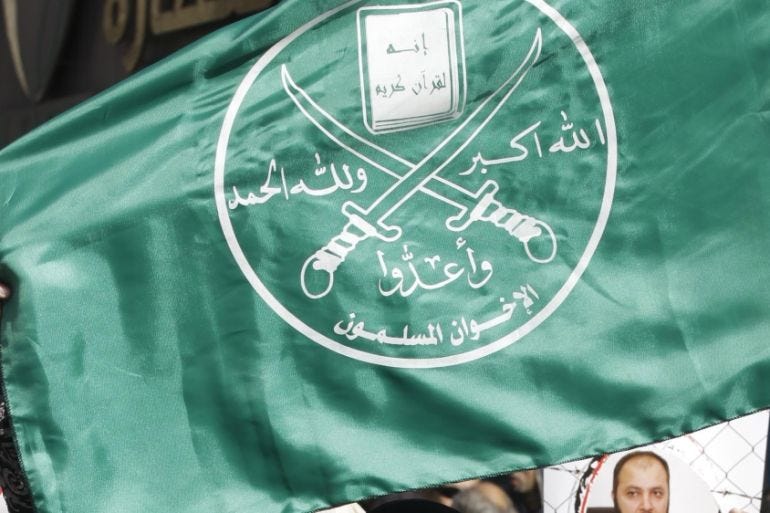
The Trump White House has finally given Saudi Arabia, the UAE and Israel what they have spent a decade asking for, at least on paper. On 24 November, President Trump signed an executive order telling Secretary of State Marco Rubio and Treasury Secretary Scott Bessent to begin designating specific Muslim Brotherhood chapters as Foreign Terrorist Organisations and Specially Designated Global Terrorists, using the Immigration and Nationality Act and the emergency sanctions law as the legal base.
The order name checks Brotherhood branches in Egypt, Jordan and Lebanon, accused of backing Hamas and “campaigns against US interests and allies” during the Gaza war. In practice, it launches a review that will end with some list of chapters and front organisations whose US assets can be frozen, whose members can be barred from travelling, and whose supporters can be prosecuted for “material support”. The message to regional allies is clearer than the legal detail. Washington is now willing to write the Brotherhood into the same sanctions architecture that already targets Hamas, Hezbollah and Iranian networks to cement the political and ideological footing of the Abraham Alliance.
The Abraham Alliance Ideological War
The push did not start in Washington. Egypt, Saudi Arabia and the UAE outlawed the Brotherhood and its affiliates years ago, and have lobbied successive US administrations to follow suit. For Cairo, this is about consolidating the 2013 coup and the criminalisation of all Islamist political opposition. For Riyadh and Abu Dhabi, it is about erasing a rival model of Sunni political legitimacy that combines Islamic language, elections and social welfare. For Israel, it is about breaking the organisational backbone of pro-Palestinian mobilisation in Jordan, Egypt the wider region, and globally.
The Gaza war gave that agenda fresh leverage. The White House fact sheet explicitly cites Brotherhood support for Hamas and alleges that an Egyptian Brotherhood leader called for violent attacks on US partners during the Gaza campaign, although it does not provide clear evidence. Israel’s government, which has long equated the Brotherhood family of movements with an existential threat, has openly praised Trump’s move and is now pushing European capitals to “align” with the US designation. The sequencing is not subtle. The US is working to cement the post-Gaza war regional order and views Islamic opposition as the key force that needs to be reckoned with by force and lawfare. The Abraham Alliance is now strategically positioning itself to prevent any opposition from arising on the backdrop of Gaza, as was the case in many countries globally. This ideological aspect opens a new chapter in the future of regimes stability in the region.
Muslim Brotherhood Reaction, And The Palestinian Question
The Brotherhood has rejected the order outright. In a statement circulated through sympathetic media, the movement denounced the executive order as politically motivated, accused the UAE and Israel of pressuring Washington, and insisted that it is a peaceful movement that participates in elections and opposes extremism. The statement explicitly links the timing to Gaza, arguing that the US administration is trying to criminalise Islamist and pro-Palestinian opposition at the very moment when images of destruction and mass death in the Strip have radicalised Arab public opinion.
By pushing a US terror and sanctions label on key Brotherhood chapters, Washington is giving regional regimes a green light to treat their infrastructure as part of the same threat complex as Hamas. Behind the language of “foreign terrorist organisations” sits a familiar objective to narrow the political space in which Gaza can become an organising banner for domestic opposition inside and outside the US.
A Sanctions Regime Cementing The Post-Gaza Regional Order
The Brotherhood is not a company with a Delaware registration or a single central office with a Chase account. It is a loose network of movements, parties, charities and student groups that share an ideological lineage but are organisationally separate. US officials and sympathetic think tanks have spent months arguing for a scalpel rather than a sledgehammer, targeting specific branches and financial vehicles instead of the entire global network. The executive order reflects that logic.
The immediate practical impact inside the US will be limited. The Brotherhood has no public, formal presence in the country, and the organisations that hardliners routinely accuse of being its “fronts”, such as CAIR, are not designated at the federal level. The most significant effects will be indirect. First, the intelligence and financial mapping that accompanies designation will travel straight back to allied security services in Egypt, Jordan and the Gulf, helping them build cases and narratives against local opponents. Second, the designation will act as a reference point for states such as France, Austria and maybe Germany that are already tightening laws around Islamist and pro-Palestinian activism.
Texas has already proclaimed the Brotherhood and CAIR “foreign terrorist and transnational criminal organisations” under state law, a move now being challenged in federal court. The federal executive order will give such efforts a stronger symbolic anchor, even if the legal pathways are messy.
The sanctions help bind the emerging post-Gaza order in which Egypt, Saudi Arabia, the UAE and Israel present themselves as the responsible core of a “stabilised” region, aligned with Washington, committed to the containment of Iran, and hostile to any Islamist or pro-Palestinian actor that challenges the settlement. The Muslim Brotherhood is the most obvious transnational brand that connects electoral Islamism, social mobilisation and the Palestinian cause. Targeting its chapters through US sanctions is less about imminent threats to American soil and more about rewriting the political field across the US and the Muslim world.
Follow us:
📱 Twitter (X): @MENAUnleashed
🎥 YouTube: MENA Unleashed
📸 Instagram: @MENAUnleashed
💼 LinkedIn: MENA Unleashed
🎵 TikTok: @MENAUnleashed