

Dear readers. MENA Unleashed is a reader-only platform with no sponsors or ads, so if you value our work please consider becoming a paid subscriber and sharing it with others, as your support keeps us independent.
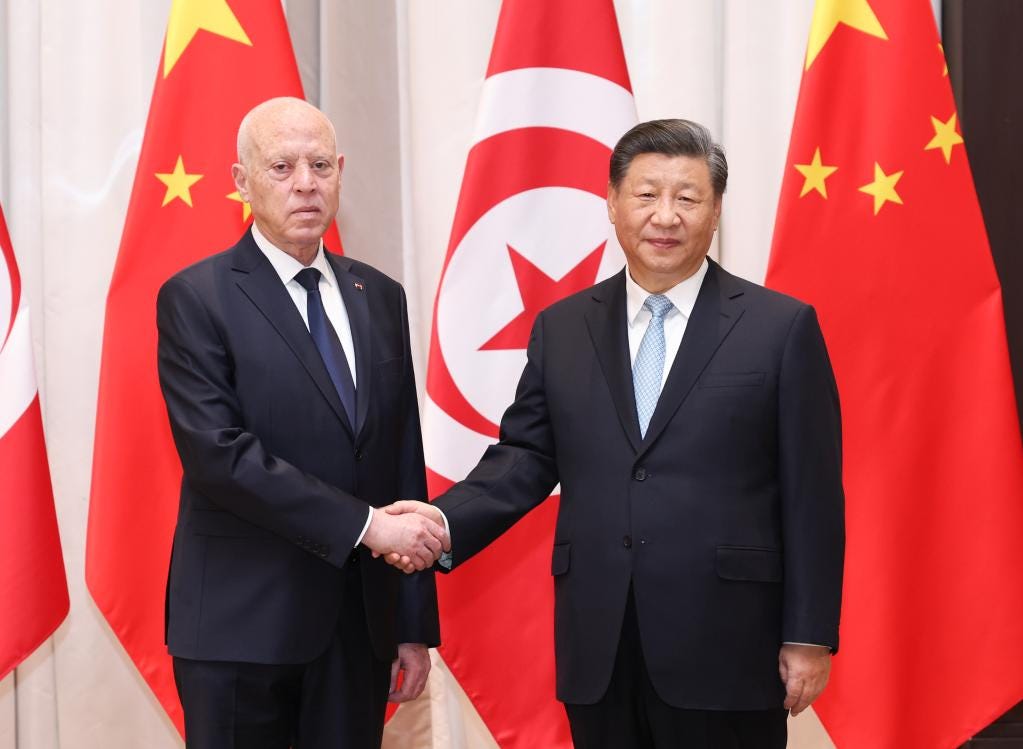
China has overtaken Italy and France to become Tunisia’s top exporter, marking a shift in North Africa’s trade. Chinese exports to Tunisia reached 6.527 billion dinars (approximately £1.92 billion) in the first seven months of 2025, representing a 37.2% increase compared to 2024, surpassing both Italy (£1.67 billion) and France (£1.58 billion). This transformation accelerated following President Kais Saied’s 2024 visit to Beijing.
Discussions are underway for an economic partnership agreement granting Tunisian products zero-tariff access to the Chinese market. Chinese investment is materialising across strategic sectors such as the reconstruction of the El Menzah Olympic Stadium, a cancer treatment centre in Gabès, and phosphate extraction ventures. The shift represents Tunisia’s careful recalibration act vs global geopolitical tension. However, Trump’s Board of Peace model may challenge Saied’s bets.
Tunisia’s Economic Calculus and Multi-Alignment Strategy
For Tunisia, the pivot towards China addresses immediate economic needs whilst creating geopolitical space beyond traditional European dependence. The country faces a widening trade deficit that reached 11.905 billion dinars (£3.5 billion) in the first seven months of 2025. China’s willingness to invest in infrastructure offers relief that European partners, preoccupied with migration control and frustrated with Saied’s authoritarian drift, have struggled to provide.
Tunisia’s embrace of Beijing forms part of a broader multi-alignment strategy that has simultaneously courted the West and the East. Under Saied, Tunisia has elevated Russia’s diplomatic standing, with cooperation spanning satellite technology to expanded partnerships, though substantive military cooperation remains absent. Tunisia also played a role in reselling Russian-sanctioned oil. This reflects Tunisia’s attempt to leverage great power competition whilst navigating regional constraints, particularly its reliance on Algerian energy supplies, financial aid, and food imports.
France (£0.6 billion in bilateral loans) and Saudi Arabia (£1 billion) remain Tunisia’s primary creditors as China’s economic engagement has not yet translated into large-scale financing packages that could fundamentally alter Tunisia’s debt dynamics. Instead, Beijing’s strategy focuses on incremental infrastructure investments that position Chinese firms within Tunisia’s economy whilst establishing a political foothold in North Africa.
For Beijing, Tunisia represents a manageable entry point into North Africa’s market, complementing its established presence in Egypt. Chinese Ambassador Wan Li explicitly positioned Tunisia as a “strategic partner” within the Belt and Road Initiative. Europe’s transactional focus on migration control has damaged its standing, projecting the EU as more than twice as likely to destabilise the region compared to China.

China’s approach contrasts with European conditionality by eschewing democracy promotion, offering infrastructure investment without governance demands. This resonates with Saied’s increasingly authoritarian governance, which has intensified crackdowns on opposition, imprisoned journalists, and extended opposition leader Rached Ghannouchi’s sentence by 22 years in early 2025. Beijing’s engagement provides legitimacy to a regime facing Western criticism whilst establishing commercial networks.
Regional Order Implications and Maghreb Fragmentation
Tunisia’s realignment intersects with existing tensions in the North African regional order. The country has abandoned traditional neutrality on Western Sahara to adopt “active neutrality” aligned with Algeria, triggering a diplomatic rupture with Morocco. This reflects economic dependence on Algiers but creates tensions, as Algeria maintains its own complex relationship with Moscow whilst wary of excessive Chinese influence in its neighbourhood.

The triangular mechanism between Egypt, Tunisia, and Algeria on Libya, reactivated in diplomatic contacts in January 2026, demonstrates continued regional coordination. However, Tunisia’s deepening extra-regional partnerships risk fragmenting Maghreb cohesion further, as countries pursue competing alignments with external powers rather than intra-regional integration. Libya’s division between Turkish-Qatari backed Tripoli and Egyptian-Emirati supported Benghazi illustrates how external patronage networks fracture rather than stabilise the region. Saudi-UAE ongoing rift is also likely to impact Tunisia’s alliances map.
The October 2025 Gaza ceasefire agreement has reshaped regional dynamics particularly. Tunisia’s recent diplomatic coordination with Egypt on Gaza in January 2026, emphasising ceasefire consolidation, demonstrates alignment with Arab countries’ positions. However, Tunisia faces underlying pressure regarding potential Israel normalisation as Trump’s Board of Peace seeks buy-ins from regional leaders.
Any normalisation would fracture Tunisia’s relationship with Algeria, its primary economic backer, whose opposition to the Abraham Accords remains persistent. Tunisia’s current economic fragility and dependence on Algerian energy, finance, and food supplies makes it more vulnerable to Trump’s pressure, especially as Libya joins the US regional efforts.
Strategic Drift or Hedging?
Tunisia’s embrace of China represents neither a wholesale abandonment of Europe nor a coherent strategic repositioning, but tactical manoeuvring within severely constrained options.
The sustainability of Tunisia’s strategy remains uncertain. Chinese investment has not materialised at the scale required to resolve Tunisia’s debt crisis. Russian partnership offers diplomatic symbolism but limited economic substance. Algerian dependence constrains strategic autonomy whilst foreclosing normalisation options. Tunisia’s positioning after the Gaza deal reveals the limits of its current strategy, leaving it peripheral to emerging regional architectures whilst accumulating competing dependencies that may prove untenable as the regional order consolidates.
📱 Twitter (X): @MENAUnleashed
🎥 YouTube: MENA Unleashed
📸 Instagram: @MENAUnleashed
💼 LinkedIn: MENA Unleashed
🎵 TikTok: @MENAUnleashed