

Parliament in Beirut is set to debate legislation that Prime Minister Nawaf Salam’s government insists will save Lebanon’s shattered financial sector. The banking bill promises to protect small depositors and unlock billions in reconstruction funds. Yet beneath the technical language of equity depletion and central bank recapitalisation lies a far more consequential struggle over Lebanon’s future alignment in a rapidly reshaping Middle East.
The legislation cannot be understood as a standalone economic measure. It represents the financial architecture through which external powers intend to bind Lebanon into Trump’s Board of Peace, the US-sponsored India-Middle East-Europe Economic Corridor and Abraham Market frameworks. Gulf states and Western governments have made their position explicit. Reconstruction aid flows only after IMF-mandated reforms pass through parliament. Lebanon’s economic sovereignty is being traded for the promise of recovery while its future is tied to external interests.

The Fayyad Playbook in Beirut
President Joseph Aoun’s election in January 2025 ended two years of political paralysis and introduced a governing approach familiar to observers of Palestinian Authority dynamics under Salam Fayyad. Between 2007 and 2013, Fayyad implemented economic governance models that Western donors praised, whilst the Palestinian Authority became perceived by many as functioning primarily to maintain Israeli and US security interests.
Nawaf Salam appears cast in a similar role for Lebanon. Both are technocrats elevated by Gulf and Western backing to implement reforms that weaken resistance movements whilst integrating their territories into US regional architecture. Aoun’s inaugural commitments to dismantle criminal networks, reform banking with transparency, and engage diaspora voters through new electoral laws align closely with Western and Gulf priorities. These measures specifically target Hezbollah’s societal standing by making reconstruction conditional on political concessions that undermine the movement’s support base.
Finance Minister Yassine Jaber frames the banking bill as protecting depositors, with guarantees up to $100,000 repaid within four years. The broader structure tells a different story. IMF requirements demand bank equity depletion before deposit deductions apply, forcing shareholders to absorb losses first. The Association of Banks in Lebanon warned the draft amounts to sector liquidation. From a strategic perspective, dismantling the traditional banking elite removes one pillar of the old order that sustained Hezbollah’s financial networks and political influence.
Integration Through Crisis
Lebanon’s economic collapse since 2019 has produced estimated losses of $70 billion. The currency has shed over 90% of its value. Poverty rates have soared whilst the state struggles to provide electricity and water. Yet this crisis has become a governance tool rather than merely a policy failure. Prolonged economic weakness keeps Lebanon dependent on external actors who leverage reconstruction funds for political realignment.
The banking bill sits at the centre of this strategy. Large depositors will receive central bank securities maturing over 10 to 20 years, backed by asset liquidation. Commercial banks must cover portions of these payments, threatening their capital base. A clause requiring state recapitalisation of the central bank if needed could impose debt burdens that trigger another default. The finance ministry must agree with the central bank on contested state debts, with experts warning that high figures risk balancing central bank books at the expense of government spending and broader economic stability.
This creates what Minister Jaber acknowledged as an impossible choice. If demands from the central bank and commercial lenders are met, parliament kills the IMF deal. If IMF requirements are fully implemented, the banking sector collapses entirely. The Catch-22 serves external interests by maintaining Lebanon in a state of controlled crisis where reconstruction funds remain perpetually conditional on further concessions.
Regional Architecture and Resistance
President Aoun’s foreign policy commitments reinforce the geopolitical reading of economic reform. He pledged to strengthen integration with Arab countries through strategic partnerships, student exchanges, tourism and investment. Whilst rhetorically opening Lebanon to both East and West, the practical focus remains on Gulf countries and Western partners. BRICS engagement appears sidelined in favour of US security guarantees and integration into the Abraham Market launched by President Biden in September 2022.

The IMEC corridor requires stable, compliant partners. Lebanon’s ongoing crisis makes it an unreliable link in the chain connecting India to Europe through Arab states and Israel. Hamas’s strategic aim has been to slow Israel’s integration into regional markets whilst the Palestinian issue remains unresolved. This succeeded in early stages of the conflict but latter phases have seen accelerated steps toward normalisation. Lebanon’s repositioning within this architecture cannot proceed whilst economic crisis persists, making the banking bill the mechanism through which geopolitical alignment is enforced.
Aoun addressed extensive damage in Southern Lebanon and the Bekaa Valley, attributing it to Israeli aggression whilst simultaneously committing to reforms demanded by the powers that enabled that aggression. He vowed to exercise state authority over all territories, including Palestinian refugee camps, and pledged to disarm these camps. His administration described relations with Syria as a historic opportunity for dialogue on sovereignty and border control. These positions align precisely with US and Israeli strategic objectives for the region.
Sovereignty or Subordination
Parliament will debate the bill formally in coming weeks, with amendments expected from multiple directions. Some MPs will push changes satisfying IMF requirements whilst others seek alignment with the central bank and commercial lenders. The outcome determines not just depositor compensation and bank survival but Lebanon’s position in the emerging Middle East order.

A preliminary IMF deal in 2022 stalled due to infighting and pushback from economic and political elites. The current government faces identical obstacles, with Lebanese Forces ministers opposing the law in cabinet. Banks and politicians accuse the state of dodging responsibility for crisis losses. Yet previous failures to pass reforms serve external interests by prolonging Lebanon’s weakened state and deepening dependence.
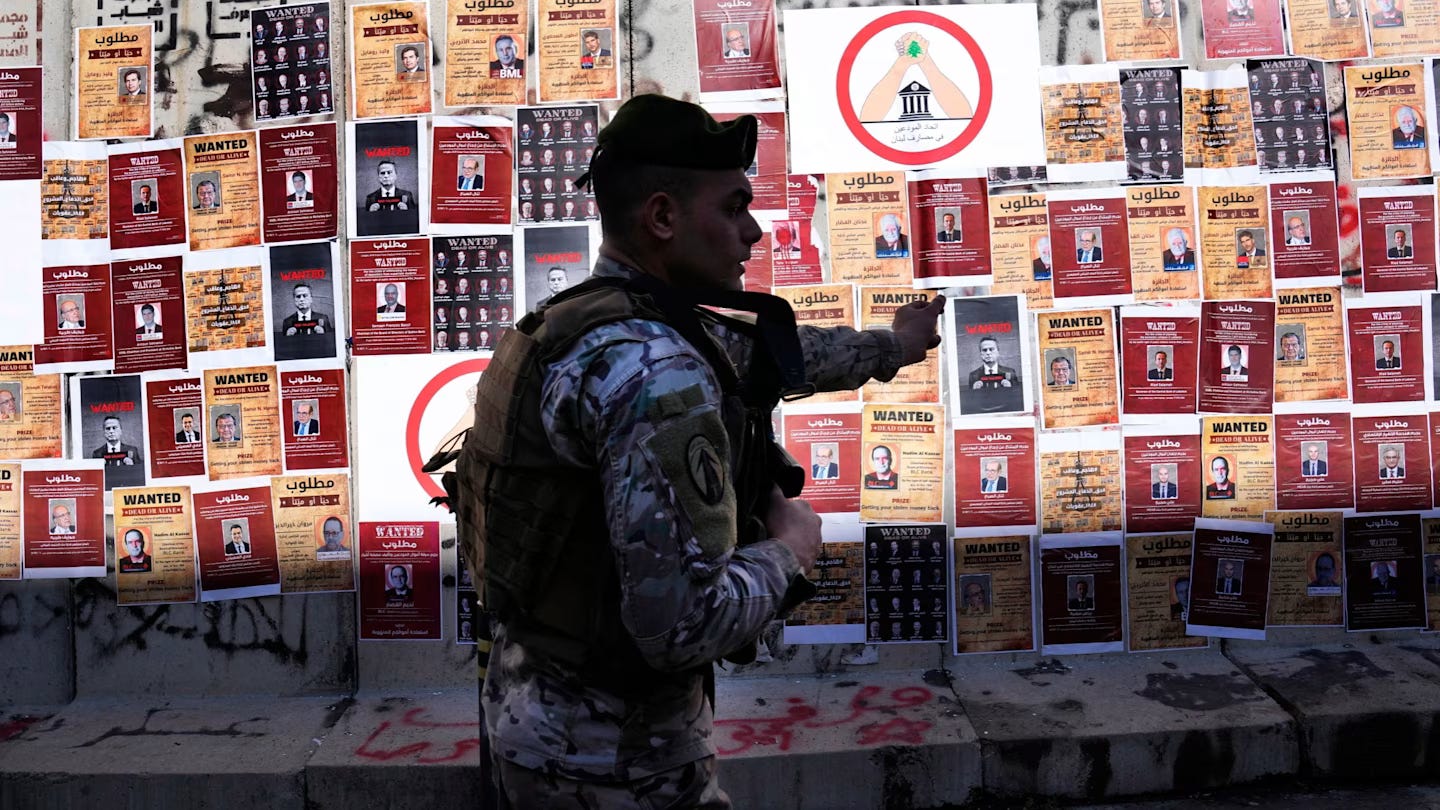
Mock wanted posters of bank executives still adorn walls outside the Central Bank, grim reminders of public anger after six years of collapse. Yet the banking bill debate proceeds as if these are technical matters rather than existential questions about who controls Lebanon’s future. Whether Lebanon emerges as a sovereign partner in regional development or a subordinate node in US-led architecture will be determined by how this legislation reshapes the economic foundations of political power.
📱 Twitter (X): @MENAUnleashed
🎥 YouTube: MENA Unleashed
📸 Instagram: @MENAUnleashed
💼 LinkedIn: MENA Unleashed
🎵 TikTok: @MENAUnleashed