

Dear readers. MENA Unleashed is a reader-only platform with no sponsors or ads, so if you value our work please consider becoming a paid subscriber and sharing it with others, as your support keeps us independent.
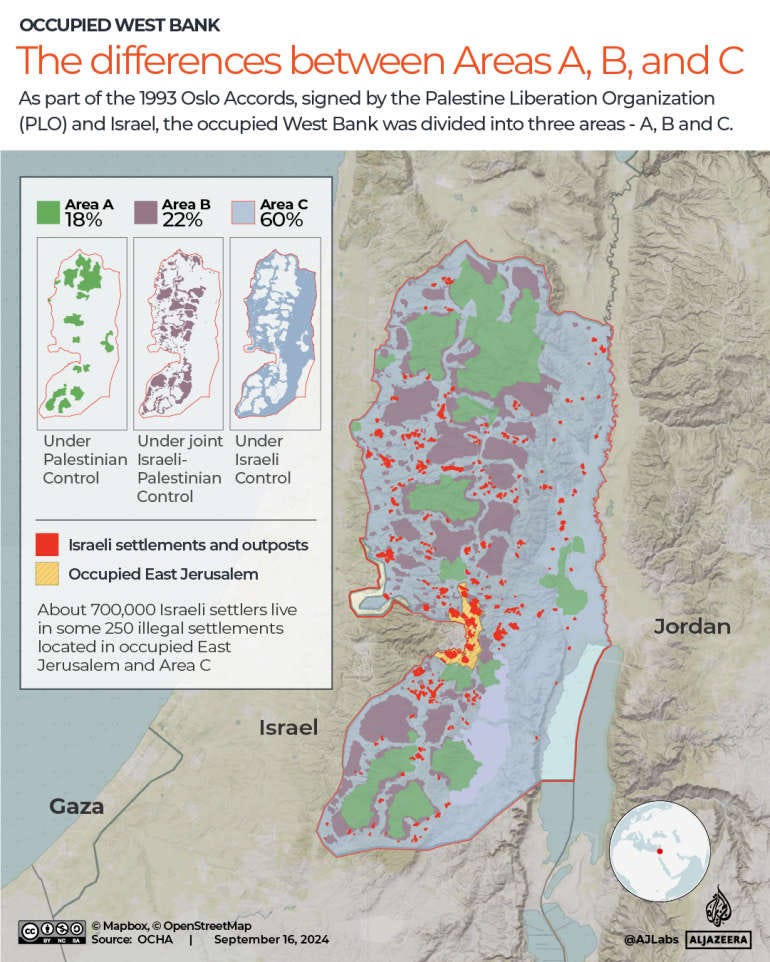
Israel’s security cabinet approved a series of sweeping administrative changes on 7 February that fundamentally alter the legal and territorial status of the occupied West Bank. The decisions remove confidentiality protections on land registries, cancel Jordanian-era prohibitions on land sales to Jews, eliminate transaction permit requirements, and transfer building authority from Palestinian municipalities to Israeli institutions in Hebron and Bethlehem. Perhaps most significantly, Israel now claims enforcement powers in Area A against Palestinian construction it deems harmful to heritage sites, effectively extending its administrative reach into territory nominally under full Palestinian Authority control under the Oslo Accords.
The measures do not formally dissolve the Palestinian Authority, but they strike at the core of its remaining functions. By creating parallel Israeli administrative systems in areas supposedly governed by the PA, the cabinet decisions hollow out Palestinian self-governance without the political cost of declaring formal annexation. Israeli officials privately acknowledge these represent the most significant policy shifts in the West Bank since 1967, implemented by a security cabinet seeking to advance sovereignty before elections scheduled for October 2026. PA Vice President Hussein al-Sheikh directed all Palestinian civil and security bodies to reject the Israeli measures entirely and adhere strictly to Palestinian law. The Palestinian President also announced a draft national constitution as retaliation. The instruction amounts to an open declaration that two separate and contradictory legal systems now claim jurisdiction over the same territory, with the PA urging its citizens to ignore Israeli directives.

The Death of the Two-State Solution
The international consensus on a two-state solution, already fragile, has effectively collapsed. The European Union condemned the Israeli measures as violating the Oslo Accords, under which Israel has no civilian authority in Areas A and B, warning they undermine the Hebron Protocol and jeopardise the sensitive status quo at religious sites. The EU stressed it does not recognise Israeli sovereignty over territories occupied since June 1967 and reiterated that annexation is illegal under international law. Yet these statements carry no enforcement mechanism. The EU proclaimed there is “no alternative to the two-state solution” whilst acknowledging the viability of that solution continues to erode with each Israeli action.
Muslim-majority states with diplomatic relations to Israel, including Jordan, Egypt, the UAE and Turkey, issued joint condemnations describing the measures as breaches of international law that threaten regional stability. Saudi Arabia reiterated it will not establish diplomatic ties with Israel until a Palestinian state is created. Yet Israel proceeds unimpeded, creating irreversible facts on the ground whilst the international community issues statements of concern.
The practical reality is that the territory required for a viable Palestinian state no longer exists in any meaningful form. The West Bank is fragmented by settlements, bypass roads and military zones. Gaza remains under blockade with its northern sections now separated by Israel’s Yellow Line, which has hardened from a temporary armistice demarcation into a permanent internal border. The PA lacks sovereignty over its own territory, control over its borders, or authority to prevent its land being sold to settlers. What remains is not the foundation for statehood but the infrastructure of permanent subordination.
Jordan’s Existential Concerns
The implications for Jordan are profound and immediate. Jordan’s Foreign Ministry condemned the repeal of Jordanian-era law barring land sales to Jews in the West Bank as an assault on Palestinian rights and a breach of international law. The language reveals deeper anxieties. Jordan administered the West Bank from 1948 to 1967, and Jordanian law still governs aspects of Palestinian civil life including property rights. Israeli abrogation of those legal frameworks challenges Jordanian sovereignty retrospectively and raises questions about the permanence of the 1994 peace treaty.
More fundamentally, Jordan’s population is majority Palestinian, and the kingdom’s stability depends on preventing mass displacement from the West Bank. Israeli settlement expansion and administrative annexation create pressure for Palestinian emigration. Far-right Israeli ministers have openly discussed population transfer. Jordan fears becoming the repository for Palestinians expelled from the West Bank, a scenario that would destabilise the Hashemite Kingdom demographically and politically. Jordan also worries about spillover violence. A West Bank uprising would generate refugee flows, cross-border attacks and pressure on Jordan to intervene on behalf of Palestinians. The kingdom cannot afford such a crisis, yet it also cannot be seen domestically as acquiescing to Palestinian dispossession.
Jordan’s position is increasingly untenable. It maintains peace with Israel whilst condemning Israeli actions that threaten to upend that peace. It urges the international community to compel Israel to reverse course whilst recognising no such compulsion will materialise. The contradiction between Jordan’s treaty obligations and its domestic legitimacy grows sharper with each Israeli measure advancing de facto annexation.
The Rising Threat of Violent Uprising
Many are warning about the growing risk of violent uprising in the West Bank. Palestinian security cooperation with Israel, already fraying, faces collapse if PA personnel are ordered to ignore Israeli directives. Fatah officials have issued increasingly provocative statements. Social media agitation has intensified. Lone-wolf attacks have increased. The Israeli security establishment itself opposed the Hebron changes, requesting delays until after Ramadan due to religious sensitivities. Those concerns were overruled by ministers prioritising ideological and electoral goals over security assessments.
The risk is not simply another intifada but fragmentation into multiple armed factions beyond PA control. Hamas seeks to expand its West Bank presence. Palestinian Islamic Jihad maintains cells throughout the territory. If the PA loses legitimacy by appearing unable to resist Israeli encroachment, armed groups fill the vacuum. Israel would likely respond with large-scale military operations in areas it has not directly controlled since Oslo. The result would be sustained urban warfare in densely populated Palestinian cities, massive casualties, and regional reverberations that could draw in Hezbollah, Iran-backed militias and Arab state populations demanding their governments act.
Regional Regime Stability Under Pressure
The cabinet decisions arrive at a moment of acute vulnerability for Arab regimes. Egypt faces economic crisis and cannot absorb Palestinian refugees from Gaza, let alone the West Bank. Jordan’s demographic balance makes any influx of Palestinians politically destabilising. The UAE and Saudi Arabia have pursued normalisation with Israel based on mutual economic and security interests, but those governments face domestic populations overwhelmingly sympathetic to Palestinians. Saudi Arabia’s refusal to normalise relations without Palestinian statehood reflects not altruism but political necessity. Crown Prince Mohammed bin Salman cannot afford to be seen embracing Israel whilst it annexes Palestinian land without triggering domestic backlash that would undermine his modernisation agenda.
The contradiction between elite calculations and popular sentiment creates explosive potential. Arab regimes maintained legitimacy partly through rhetorical support for Palestinians whilst avoiding material confrontation with Israel. That equilibrium depended on at least the appearance of a political process leading toward Palestinian statehood. Israeli actions demolish that fiction. Arab governments condemn whilst remaining functionally passive. Their populations notice the gap between words and deeds. The risk is not coordinated state action against Israel, which no Arab government contemplates, but rather internal instability as populations lose faith in regimes unable or unwilling to respond to what they perceive as historic injustice.
Turkey under Erdogan has positioned itself as defender of Palestinian rights, leveraging the issue for domestic popularity and regional influence. Turkish condemnations of Israeli actions serve Erdogan’s narrative of Turkey as leading Muslim power challenging Western hypocrisy. Egypt’s Sisi government, by contrast, coordinates quietly with Israel on Gaza and cannot afford populist posturing that might jeopardise that relationship. The divergence between Turkish rhetoric and Egyptian pragmatism reflects deeper fractures within the regional order, with Palestinian dispossession serving as catalyst for competing visions of Arab and Muslim politics.
Trump’s Rhetorical Red Line Without Enforcement
President Trump stated clearly in September 2025 that he would not allow Israel to annex the West Bank, declaring “no way, I will not allow it. It’s not going to occur.” Following the cabinet decisions, a White House official reiterated Trump’s opposition, stating “a stable West Bank keeps Israel secure and is in line with this administration’s goal to achieve peace in the region.” Trump himself told reporters “I am against annexation. We have enough things to think about now. We don’t need to be dealing with the West Bank.”
Yet Israel proceeded with measures that constitute de facto annexation and the Trump administration has taken no action to reverse them. The contradiction is glaring. Trump claims to oppose annexation whilst his administration’s passivity enables it. Netanyahu understands that American words without enforcement mechanisms are diplomatically convenient cover rather than genuine constraints. The Israeli Prime Minister has mastered the art of nodding to American concerns whilst advancing maximalist territorial ambitions. Trump’s statements allow both leaders to maintain fictions: Trump can claim he opposed annexation, Netanyahu can claim he respected American wishes whilst achieving annexation by administrative means rather than formal declaration.
Expansion as Coherent Strategy
The West Bank measures fit within broader Israeli territorial expansion across multiple fronts. In Gaza, the Yellow Line has been unilaterally moved eastward, bringing more territory under permanent Israeli control. Defence Minister Katz stated Israeli forces would remain in southern Syria “for an indefinite period” whilst Netanyahu demands complete demilitarisation of Syrian provinces and withdrawal of Syrian forces from territory south of Damascus. Reports suggest Israeli proposals involving Syria regaining one third of the Golan Heights in exchange for annexing Sunni regions in northern Lebanon and the Beqaa Valley. In Lebanon itself, Israel refuses to comply with the November 2024 cessation of hostilities agreement, maintaining forces in occupied areas and conducting daily bombardments.
These actions represent coherent strategy rather than opportunistic improvisation. Israel seeks to establish territorial depth through permanent control of strategic areas justified through security rhetoric whilst advancing settlement projects that make withdrawal politically impossible. Hence, Israel West Bank steps will likely ignite regional tensions.
📱 Twitter (X): @MENAUnleashed
🎥 YouTube: MENA Unleashed
📸 Instagram: @MENAUnleashed
💼 LinkedIn: MENA Unleashed
🎵 TikTok: @MENAUnleashed