

Dear readers. MENA Unleashed is a reader-only platform with no sponsors or ads, so if you value our work please consider becoming a paid subscriber and sharing it with others, as your support keeps us independent.
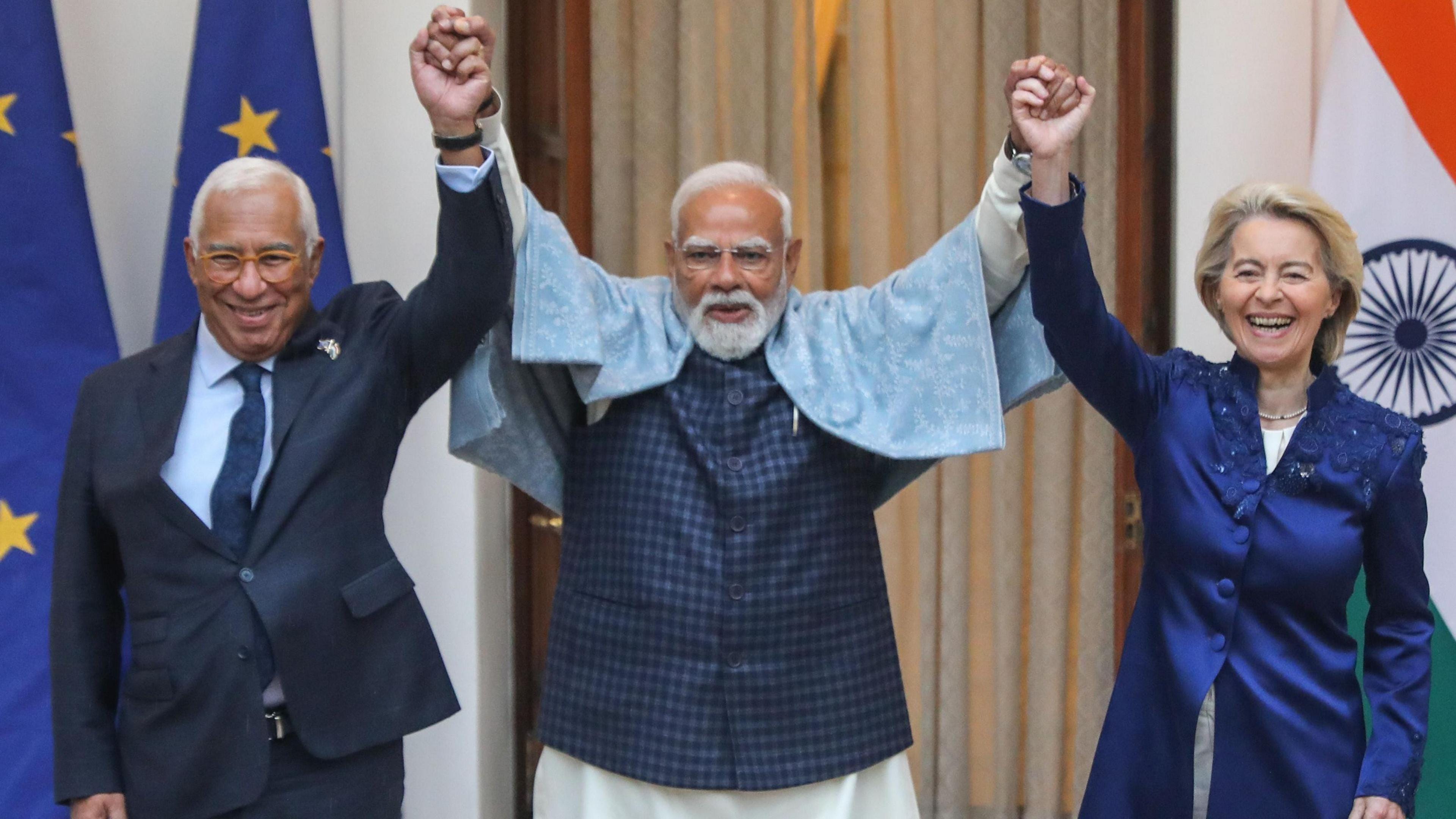
The EU-India Free Trade Agreement, finalised on 27 January 2026, is not just another trade deal. It is the institutional cement that transforms the India-Middle East-Europe Economic Corridor (IMEC) from an infrastructure proposal into a fully functioning trade bloc. More importantly, it marks a global split between competing visions of order: democratic market integration versus transactional strongman diplomacy. As Trump’s Board of Peace draws over 35 nations into a chairman-for-life model and China’s Belt and Road Initiative continues to expand, the world is fragmenting into rival architectures.

The EU-India agreement brings 1.4 billion Indians and 450 million Europeans into a framework that eliminates more than 90% of tariffs, with 30% of goods receiving immediate zero-tariff treatment. Under the deal, India would dismantle industrial tariffs that average above 16% on machinery (up to 44%), chemicals (up to 22%), and pharmaceuticals (11%), saving EU companies an estimated €4 billion annually. Indian automotive tariffs, currently reaching 110%, drop to 10% under a 100,000-vehicle quota, nearly three times what India offered the UK. For Indian exporters, the EU eliminates tariffs immediately on $33 billion of goods, including textiles, marine products (currently taxed up to 26%), leather, chemicals, and footwear. Within seven years, 93% of Indian goods would enter the EU duty-free.
The real significance lies in how this agreement completes a chain of bilateral deals along the IMEC route. India already has a free trade deal with the UAE and a deepening trade agenda with Israel. The UAE has one with Israel, exempting around 96% of goods under the Abraham Accords framework. Greece connects through EU membership. Jordan, where Modi announced a $5 billion trade target during his December 2025 visit, is integrating through infrastructure and energy agreements. These overlapping frameworks now cover 2.5 billion people across the EU, India, the Gulf states, Israel, and Jordan. This is not yet a seamless customs union, with diagonal cumulation provisions allowing frictionless movement across all nodes, but the political commitments and institutional scaffolding of a bloc are being laid.
IMEC’s Security Problem
Nonetheless, IMEC means little without the security guarantees that make it viable. IMEC’s entire value proposition depends on stable passage through two of the world’s most contested maritime zones: the Red Sea and the Eastern Mediterranean. Both are active conflict theatres. Houthi attacks on commercial shipping since November 2023 have forced vessels to detour around the Cape of Good Hope, adding weeks to transit times and massive fuel costs. These attacks specifically target vessels with Israeli or Western connections, transforming maritime security from a logistical concern into a daily operational hazard. The Bab el-Mandeb Strait, through which some IMEC traffic passes, requires a coordinated naval presence to maintain open lanes. Hezbollah attacks on the port of Haifa, envisioned as a critical IMEC hub, have shattered its image as a reliable logistics node and elevated insurance costs that undermine any theoretical efficiency advantages.
Only the United States possesses the naval capabilities to credibly secure these passages. European forces lack the capacity. India’s blue-water capabilities do not extend effectively into these theatres. Israel can defend its immediate waters but cannot secure the entire sea lanes. The UAE and Saudi Arabia have capable forces but insufficient reach for extended operations across these distances. IMEC’s viability, therefore, depends entirely on a continued American security commitment to protecting freedom of navigation at precisely the moment Trump is constructing alternative frameworks that compete with IMEC’s architecture. This creates a contradiction for IMEC as an alternative to Trump’s model while simultaneously depending on the U.S. military to make that alternative viable.
China and the “Board of Peace” Factor
Understanding IMEC requires acknowledging that it exists as a response to the Chinese Belt and Road (BRI). The BRI has created dependencies across Asia, the Middle East, and increasingly Africa that some governments find uncomfortable. Chinese infrastructure financing can come with strings that constrain sovereign decision-making, create debt issues, and embed surveillance capabilities into critical systems. IMEC represents a rule-based trade system rather than Beijing-centric networks.
China is excluded from IMEC by design. Beijing recognises this as a direct challenge to BRI dominance and has responded through enhanced engagement with countries bypassed by the corridor, particularly Turkey, as well as deepening commitments in Pakistan. The EU-India FTA strengthens the non-Chinese alternative by creating preferential trade terms along IMEC routes, making it more commercially attractive for businesses seeking to diversify away from Beijing-dependent supply chains.
Trump’s Board of Peace represents a fundamentally different model that competes directly with IMEC’s vision. Created through a UN Security Council resolution as part of Trump’s Gaza peace plan, the Board now includes over 35 countries, with Trump serving as chairman for life. The charter designates Trump as having the authority to appoint executive board members and establish or dissolve subsidiary bodies, with permanent seats available to countries contributing $1 billion. Membership includes Saudi Arabia, UAE, Egypt, Turkey, Pakistan, Belarus, with Russia reportedly considering participation. Libya has signed agreements using the Board of Peace template, extending Trump’s model into another authoritarian context.

This is a model that emphasises transactional diplomacy structured around personal relationships with strongmen who can deliver commitments without parliamentary scrutiny or public consultation. The Board’s focus on Gaza governance and “other global challenges” creates a parallel architecture for Middle East engagement that competes with IMEC’s integration model. Islamabad’s inclusion in Trump’s flagship regional initiative while India anchors IMEC alongside Israel and Gulf states embeds longstanding Indo-Pakistani tensions into rival models.
Saudi Arabia’s simultaneous participation in both frameworks exposes the hedging strategies at play. Riyadh joined Trump’s Board of Peace while remaining central to IMEC planning. Yet Saudi Arabia refuses to sign a free trade agreement with India or the EU, protecting its domestic market even as it supports corridor development. Saudi-Israeli normalisation remains the missing piece that would unlock IMEC’s full potential. MBS continues to demand Palestinian statehood with East Jerusalem as capital before establishing diplomatic relations with Israel. This creates fundamental uncertainty about whether Saudi territory will be available for corridor transit or whether IMEC must route through more complex pathways.
Jordan positions itself more decisively within the IMEC framework. Modi’s December 2025 visit, the first full visit by an Indian prime minister to Jordan, established a $5 billion bilateral trade target and produced agreements on renewable energy, water resources, digital payments integration, and infrastructure cooperation. Jordan has also signed several billion dollars’ worth of deals with the EU recently. King Abdullah II positioned Jordan as “a bridge that connects markets and regions”, explicitly embracing the connectivity role IMEC assigns the kingdom.
The New World (Dis)order
What emerges from these developments is not a multipolar world with shared rules and institutions but fragmentation into competing blocs with fundamentally incompatible governance models. Trump’s Board of Peace operates through personalised authority, transactional deals with strongmen, and permanent chairmanship unconstrained by term limits or institutional checks. IMEC represents democracies and institutions building connectivity through negotiated trade agreements, national ratifications, institutional cooperation frameworks, and rule-of-law structures. China’s Belt and Road constitutes state-directed infrastructure financing that creates Beijing-centric networks with embedded dependencies. These are not simply different approaches to similar goals. They represent fundamentally incompatible visions of how international commerce, political authority, and institutional legitimacy should function.
📱 Twitter (X): @MENAUnleashed
🎥 YouTube: MENA Unleashed
📸 Instagram: @MENAUnleashed
💼 LinkedIn: MENA Unleashed
🎵 TikTok: @MENAUnleashed